

Why This Matters Now
AI agents are moving from demo territory into real software systems. That shift is why developers are suddenly hearing more about protocols than prompts. On March 18, 2026, Google published its Developer's Guide to AI Agent Protocols, bringing six protocols into one practical architecture: MCP, A2A, UCP, AP2, A2UI, and AG-UI. Google's core message is simple: these are not random competing standards. They solve different layers of the agent stack.
This matters because the biggest problem in agent engineering is no longer just model quality. It is integration complexity. An agent may need to search docs, use APIs, talk to another specialist agent, request approval, complete a purchase, and return a UI that users can actually interact with. Without shared protocols, each step becomes custom plumbing. Google's guide, along with related docs for A2A, UCP, A2UI, AG-UI, and MCP integrations, is essentially a map for reducing that plumbing.
What Are AI Agent Protocols?
AI agent protocols are shared rules that define how agents communicate with tools, other agents, users, and transaction systems. They do for agent ecosystems what HTTP and APIs did for web software: they replace one-off integrations with repeatable patterns. A2A's official docs describe it as an open standard for communication between AI agents, while Google's MCP materials position MCP as the standardized bridge between AI systems and external tools or documentation.
The easiest way to think about this is by layer. One protocol helps an agent use tools. Another helps it delegate work to other agents. Another helps it handle commerce safely. Another helps it render UI. Another helps the frontend stay in sync with the backend agent in real time. This layered view is exactly how Google's guide explains the ecosystem, and it is the most useful mental model for developers trying to decide what to adopt first.
Key Insight: These are not competing standards — each protocol solves a distinct layer of the agent stack. The value comes from using the right protocol at the right layer, not from picking a single winner.
The Six AI Agent Protocols You Should Know
1) MCP: Agent-to-Tool Communication
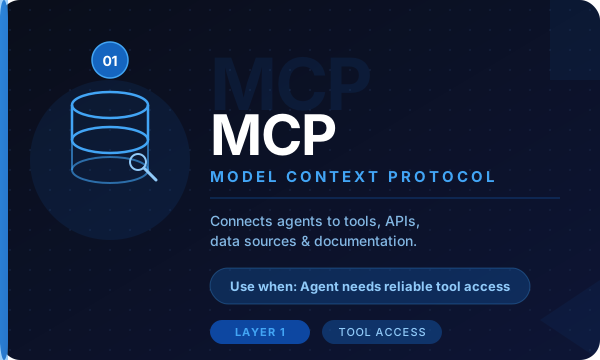
Model Context Protocol (MCP) is the protocol you use when your agent needs access to tools, APIs, data sources, or documentation. Google's Developer Knowledge MCP server is a good real example: it lets AI-powered tools search Google's official developer docs and retrieve full content through standardized MCP tools instead of a custom integration. Google also recently released new MCP experiences such as the Colab MCP server and Google-managed MCP tooling, which shows how central MCP has become in agent development.
Use MCP when your problem is: "My agent needs reliable access to systems and context."
2) A2A: Agent-to-Agent Communication

Agent2Agent (A2A) is the layer for agent collaboration. Google introduced A2A in April 2025 so agents could securely exchange information and coordinate actions across enterprise platforms and applications. The official A2A docs now describe it as an open standard, originally developed by Google and donated to the Linux Foundation, for interoperability across agents built with different frameworks and by different vendors.
Use A2A when your problem is: "One agent should hand work to another specialized agent instead of trying to do everything itself."
3) UCP: Commerce Workflows for Agents
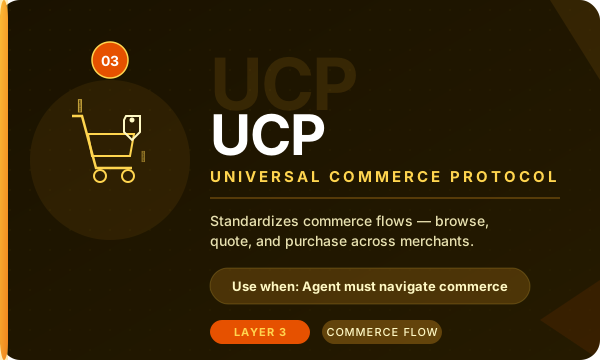
Universal Commerce Protocol (UCP) is the commerce layer. Google introduced it in January 2026 as an open standard for agentic commerce, designed to create a common language between consumer surfaces, businesses, and payment providers. Google's docs say UCP is designed to support agentic actions in Google AI Mode and Gemini, beginning with direct buying, and that it works with A2A, MCP, and AP2.
Use UCP when your problem is: "My agent needs a standard way to browse offers, get quotes, and move through a commerce flow without custom APIs per merchant."
4) AP2: Trust, Authorization, and Payment Control
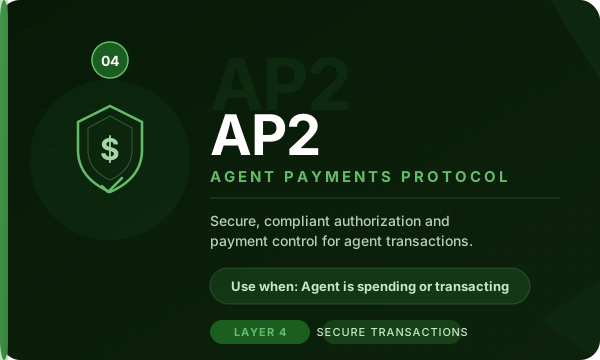
Agent Payments Protocol (AP2) is the payment and authorization layer. Google Cloud describes AP2 as an open shared protocol for secure, compliant transactions between agents and merchants, supporting multiple payment types and helping create traceable, scalable payment workflows. In practice, this is the layer that makes agentic commerce safer because it adds structure around approval, authorization, and payment handling.
Use AP2 when your problem is: "The agent is about to spend money or commit a transaction, and I need explicit control, compliance, and auditability."
5) A2UI: UI Generated by the Agent

A2UI is the protocol for agent-generated interfaces. Google introduced A2UI publicly in December 2025 as an open project for secure, declarative, updateable UIs that agents can send to frontends. Google says the frontend still owns the rendering, while the agent sends UI definitions rather than executable code. The Workspace quickstart shows A2UI being used with ADK and Vertex AI Agent Engine inside Google Chat.
Use A2UI when your problem is: "The agent should return not just text, but a structured form, card, dashboard, or task-oriented interface."
6) AG-UI: Real-Time Connection Between Agent and App
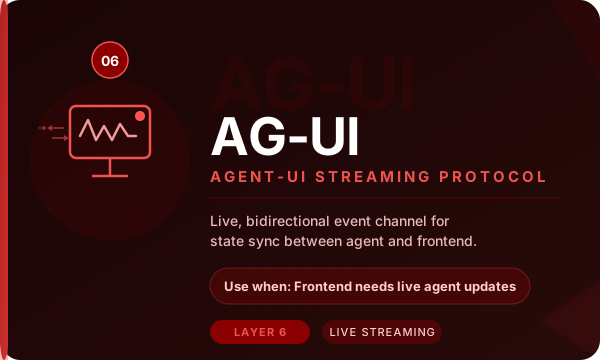
AG-UI is different from A2UI. AG-UI is an event-based protocol for the live connection between an agent backend and a user-facing application. Its docs define it as a lightweight, bidirectional standard for agent state, UI intents, and user interaction flow. Google's ADK integration docs describe AG-UI as the protocol that handles streaming events, client state, and bidirectional communication between agents and users.
Use AG-UI when your problem is: "My frontend needs streaming updates, user actions, and state sync with the agent."
A Simple Way to Understand the Stack
Here is the clearest developer-friendly framing for what each protocol does:
| Protocol | Layer | What It Solves |
|---|---|---|
| MCP | Tool & Data Access | Helps an agent use tools and data |
| A2A | Agent Collaboration | Helps an agent talk to other agents |
| UCP | Commerce Workflows | Helps an agent move through commerce flows |
| AP2 | Payments & Authorization | Helps an agent transact safely |
| A2UI | Agent-Generated UI | Helps an agent describe UI |
| AG-UI | Real-Time Frontend Channel | Helps an app stay connected to an agent in real time |
That layered interpretation is consistent with Google's guide, A2A documentation, and AG-UI's own architecture docs. It is also the main reason this topic is getting so much attention now: the industry is moving from isolated copilots to interoperable systems.
Example: How These Protocols Work Together in One Real System
Imagine you are building a procurement agent for an operations team. A user asks:
"Find the best replacement laptops for 20 designers, check delivery timelines, show me the options, and place the order after my approval."
Here is how the protocol stack could work:
- The main agent uses MCP to connect to internal budget policies, vendor APIs, and documentation.
- It then uses A2A to delegate sourcing to a specialist vendor-comparison agent and routing to a logistics agent.
- Once suppliers are identified, UCP standardizes how the system requests offers and structures the commerce flow.
- Before any purchase happens, AP2 handles the authorization and payment step with approval controls.
- The agent then returns a comparison interface using A2UI.
- The web app or internal portal stays synced with the agent through AG-UI while the user reviews, asks follow-ups, and approves the final decision.
This exact layered logic matches the role each protocol is designed to play in official Google and protocol documentation. That is the big shift: instead of treating an "AI agent" as a single chat box, you start treating it like a distributed software system with defined contracts between layers.
How Developers Should Start Using These Protocols
The biggest mistake is trying to adopt all six protocols on day one. You do not need that. A better adoption path is:
-
1Start with ADK and MCP
Google's ADK is explicitly positioned as a flexible, model-agnostic framework for building and orchestrating agents, and MCP is the simplest first interoperability layer for tool access. If you are building your first useful agent, this is where to begin.
-
2Add A2A when specialization appears
Once your system starts needing dedicated agents for research, routing, planning, compliance, or domain-specific execution, A2A becomes useful. Google's ADK docs and A2A guides both support this progression.
-
3Add AG-UI for production user experience
If your agent has a serious frontend, streaming events and state sync matter. Google's ADK integration docs point to AG-UI for this exact reason.
-
4Add A2UI when text is not enough
When your agent needs to return forms, structured panels, approvals, or rich task UIs, A2UI becomes valuable. Google's Workspace quickstart is a practical sign that this is becoming a real implementation path, not just a concept.
-
5Add UCP and AP2 only for commerce and transactions
Not every agent needs commerce or payment rails. But if your agent is making purchases, negotiating offers, or acting inside a buying workflow, UCP and AP2 are the protocols to study.
Common Mistakes Developers Should Avoid
- Comparing protocols as if one should replace the others. Google's guide is clear that the value comes from using the right protocol at the right layer, not from picking a single winner.
- Putting commerce or payment behavior directly into tool calls without a clean authorization model. That is exactly the gap AP2 is trying to solve.
- Treating UI as an afterthought. A2UI and AG-UI both exist because production-grade agents need better user interaction patterns than plain text. One gives you agent-defined UI payloads, the other gives you the live interaction channel.
- Assuming protocols only matter for large enterprises. In reality, protocols start paying off the moment your agent touches more than one external system or more than one specialist workflow. That is why Google keeps framing agent building as software engineering, not just prompt engineering.
Final Takeaway
The real lesson from Google's new Developer's Guide to AI Agent Protocols is not that developers suddenly need to memorize six new acronyms. It is that agent systems are maturing into a protocol stack.
If MCP gives agents access to tools, A2A gives them collaboration, AG-UI gives them a live frontend channel, A2UI gives them structured UI payloads, UCP gives them commerce workflows, and AP2 gives them safe transaction control, then the next generation of agent products will be built less like chatbots and more like interoperable software systems.
The Shift to Watch in 2026: Developers who understand this protocol stack early will be able to build more capable, more composable, and more production-ready AI agent systems — faster than those who keep treating every agent as a custom one-off integration.