
AI agents began with a simple promise: give the system a goal, let it use tools, and get the work done.
That alone changed the way people looked at AI. A chatbot could explain how to fix a bug. An agent could inspect the repository, edit the file, run the test, and come back with evidence. A chatbot could suggest a market research plan. An agent could search, compare, summarize, and produce the first draft.
But the conversation around agents is changing again.
The next question is not only, "Can one AI agent complete this task?" The more interesting question is, "Can many agents interact with each other in a controlled environment so we can understand what might happen next?"
That is where agent swarms come in.
An agent swarm is not just a bigger chatbot or a group of agents thrown into a workflow. It is a way to model interaction. Instead of using one AI agent to produce one answer, a swarm uses multiple agents with different roles, goals, memories, constraints, and tools. These agents act, react, negotiate, fail, adjust, and sometimes reveal patterns that a single direct prompt would miss.
In simple terms:
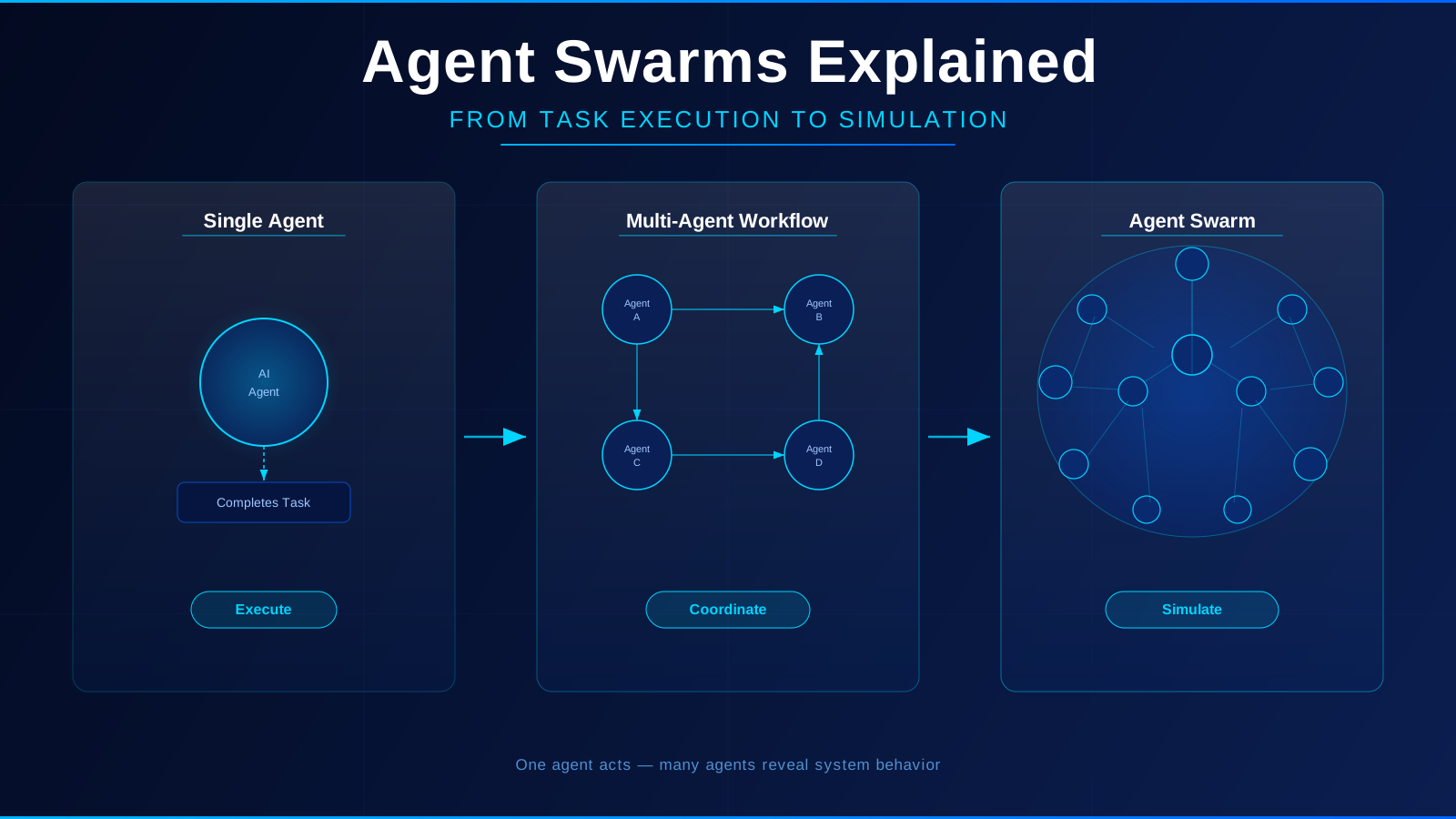
A single agent helps you execute a task.
A multi-agent workflow helps you divide work.
An agent swarm helps you simulate interaction.
That shift from execution to simulation is why agent swarms are becoming an important topic in AI engineering, product strategy, market research, software development, policy testing, and enterprise automation.
What Is an Agent Swarm?
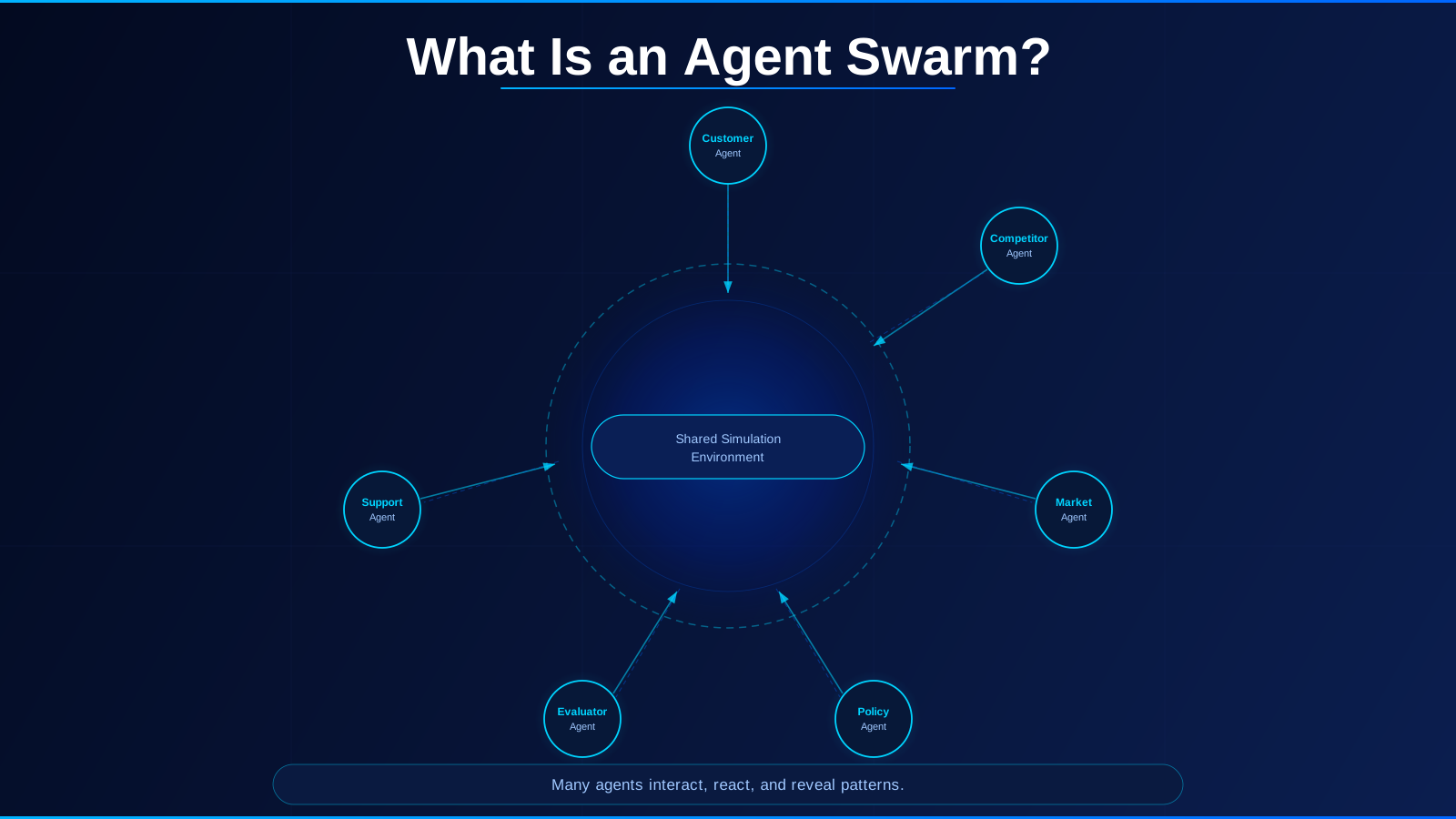
An agent swarm is a group of AI agents that operate inside a shared task, system, or simulated environment. Each agent may have its own role, context, memory, tools, and objective.
A basic agent loop looks like this:
Goal -> Plan -> Tool use -> Observation -> Next step -> ResultA swarm looks more like this:
Scenario
|
V
Multiple agents with different roles
|
V
Agents act and react
|
V
The environment changes
|
V
The system observes the pattern
|
V
A report, evaluator, or human reviews the outcome
The important phrase here is act and react.
If one agent is only calling another agent in a fixed order, that is usually a multi-agent workflow. It may still be useful, but it is not always a swarm in the deeper sense. A swarm becomes interesting when the agents influence each other or the environment.
For example, imagine testing a new pricing model for a SaaS product. A single agent might list possible customer objections. A swarm could simulate different customer groups, sales reps, competitors, support teams, finance leaders, and public commentators. One group complains about the pricing. Another group accepts it because the value is clear. A competitor uses it in their messaging. The sales team starts seeing a specific objection. The support team sees confusion around plan limits.
That chain reaction is the value.
Why Agent Swarms Are Getting Attention Now
Agent swarms are trending because several parts of the AI ecosystem matured at the same time.
First, LLMs became better at tool use and long-horizon reasoning. Second, agent frameworks started giving developers cleaner ways to manage state, tools, handoffs, tracing, and guardrails. Third, companies began moving from AI demos to operational systems, where one prompt is not enough.
OpenAI's Agents SDK describes agents as applications that can plan, call tools, collaborate across specialists, and maintain enough state to complete multi-step work. OpenAI's earlier Swarm project was an educational experiment around lightweight multi-agent orchestration, especially agents and handoffs.
Anthropic has also shown why multi-agent systems are useful for open-ended research. In its engineering write-up on a multi-agent research system, Anthropic describes a lead agent that coordinates parallel subagents, each investigating part of a broader question.
LangChain's Harrison Chase takes a more practical view in How and when to build multi-agent systems. The key point is not that multi-agent systems are always better. It is that they are useful when the work can be split cleanly and when each agent can operate with the right context.
Microsoft has moved in the same direction with its Agent Framework, which combines ideas from AutoGen and Semantic Kernel for single-agent and multi-agent orchestration, state management, telemetry, and enterprise-grade agent development. Google Cloud has also published a multi-agent AI system reference architecture, describing coordinator agents, specialized subagents, runtimes, and interoperability patterns.
Even the standards conversation is shifting. The Linux Foundation announced the Agentic AI Foundation, with support around open agent standards such as MCP, AGENTS.md, and Goose. This matters because agents are no longer being treated as isolated tools. They are becoming systems that need to talk to other systems.
The online discussion reflects the same tension. On Reddit and Hacker News, builders are excited about specialized agents, but they are also skeptical about complexity, cost, and debugging. That skepticism is healthy. Agent swarms are powerful, but they are not a shortcut around good engineering.
From Task Execution to Simulation
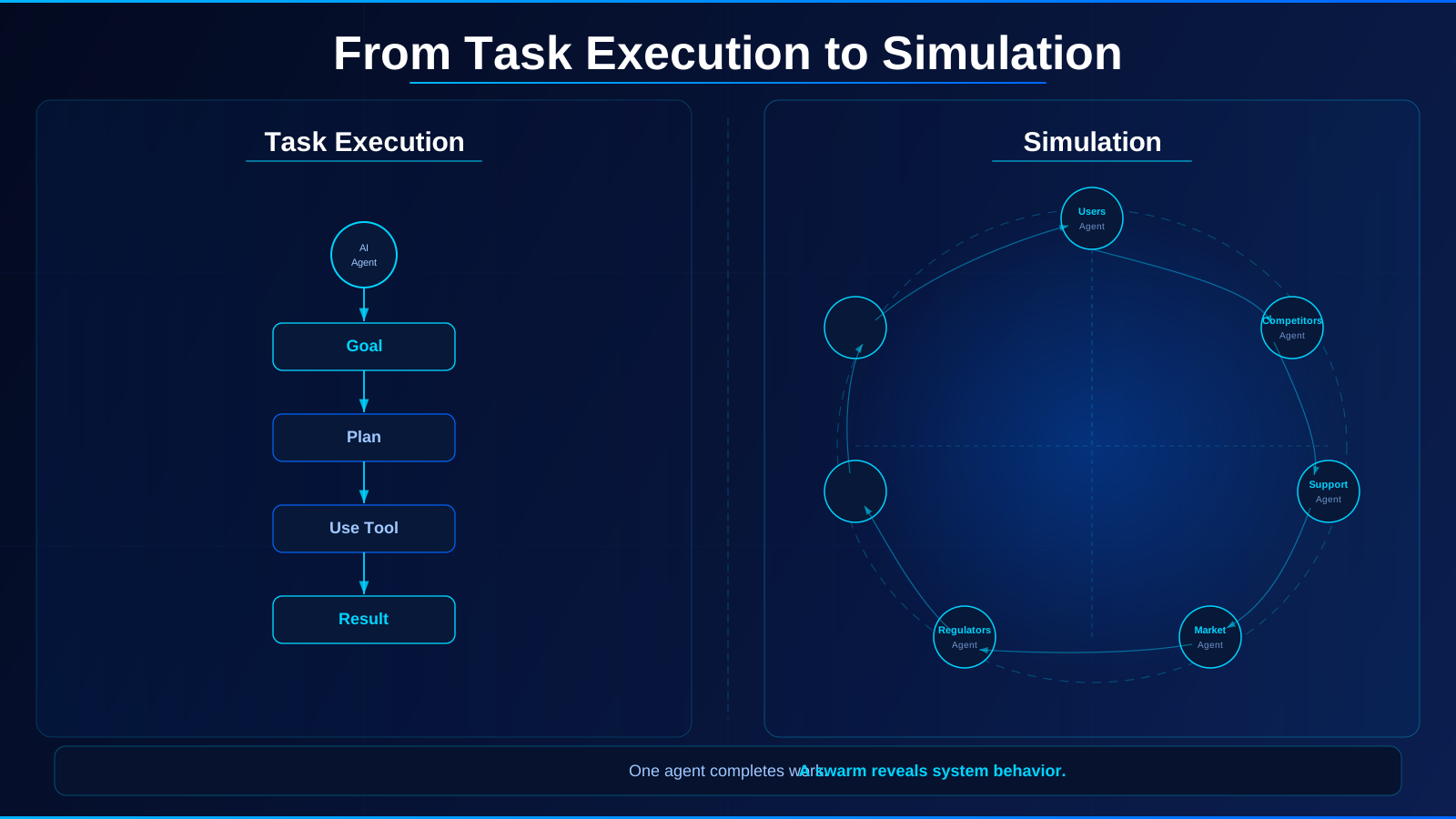
The first generation of practical agents focused on task execution.
Examples:
- Fix this bug.
- Summarize these documents.
- Draft this email.
- Research this company.
- Create a pull request.
- Generate a sales brief.
- Book a meeting.
These are goal-oriented tasks. You can define success. The agent either completed the task or it did not.
But many important questions do not work that way.
Consider these:
- How will customers react if we change pricing?
- What kind of objections will appear after launch?
- How will a new policy be interpreted by different groups?
- What happens when competitors respond to our announcement?
- How will support operations behave under a sudden spike?
- What risks appear when multiple AI agents operate in the same business workflow?
These are not simple execution problems. They are system behavior problems.
A single model can still answer them, but it will usually compress the whole situation into one response. A swarm gives you a different method. It creates a small world, fills it with agents, gives them incentives and constraints, and lets them interact.
That is why the shift matters.
Single-agent AI answers or executes.
Multi-agent workflows divide and coordinate work.
Agent swarms rehearse how a system may behave.
The word "rehearse" is important. A swarm should not be treated as a crystal ball. It is a decision rehearsal layer. It helps teams find weak spots, second-order effects, and possible reactions before they commit to a real-world move.
The MiroFish Example: Swarms as Scenario Engines
One of the clearest examples of simulation-first agent swarms is MiroFish.
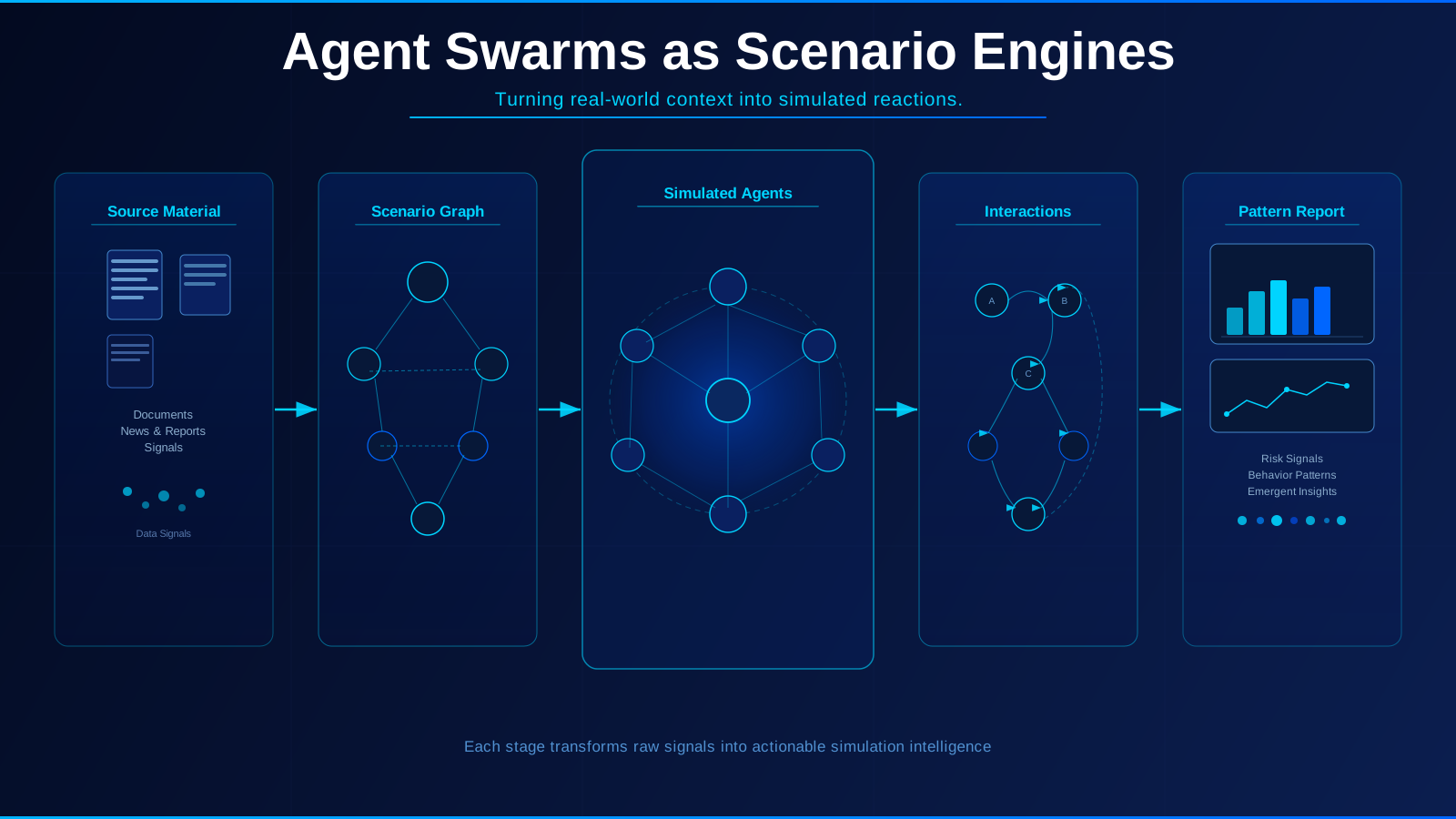
MiroFish describes itself as a swarm intelligence engine powered by multi-agent technology. The basic idea is to take seed information from the real world, such as news, policy drafts, financial signals, reports, or other source material, and use it to construct a parallel digital environment. Inside that environment, many agents with personalities, memories, and behavioral logic interact.
The workflow is easier to understand like this:
Source material
|
V
Scenario graph
|
V
Simulated environment
|
V
Many agents
|
V
Interaction over time
|
V
Forecast-style report
This is very different from asking one AI model, "What will happen?"
A MiroFish-style system tries to model how different actors might react to each other. If the scenario is a product launch, the environment may include early adopters, skeptical buyers, competitors, journalists, support teams, internal stakeholders, and regulators. Each one sees the situation from a different angle. The interesting part is not only what each agent says. The interesting part is how the reaction spreads.
MiroFish is connected conceptually to OASIS, an open-source social media simulator from CAMEL-AI. OASIS is designed to mimic large-scale social media behavior using LLM agents and rule-based agents. Its documentation describes simulations with actions such as following, commenting, reposting, and interacting with recommendation systems. The OASIS research paper frames this as a way to study information spread, group polarization, herd behavior, and other social dynamics.
That is the bigger lesson: agent swarms are not only about automating work. They are becoming a way to test social, market, organizational, and behavioral dynamics inside a controlled environment.
Agent Swarms vs Multi-Agent Workflows
People often use "agent swarm" and "multi-agent workflow" as if they mean the same thing. They are related, but they are not identical.
A multi-agent workflow usually divides a task into specialized steps.
Planner agent -> Research agent -> Writer agent -> Reviewer agentThis pattern is useful. It gives each agent a narrower responsibility. It can improve focus, reduce context confusion, and make review easier.
An agent swarm is different because the agents are not only passing work forward. They are interacting.
Customer agents + competitor agents + media agents + support agents + internal teams
|
V
Each group reacts to the same event
|
V
Their reactions influence the next state of the system
|
V
The simulation reveals patterns
A simple way to separate them:
| System type | Main purpose | Best use case |
|---|---|---|
| Single agent | Complete one defined goal | Coding, writing, research, support |
| Multi-agent workflow | Split complex work into roles | Research pipelines, software tasks, operations |
| Agent swarm | Model interaction between actors | Product launches, market reactions, public response, scenario planning |
This distinction matters because "more agents" can sound impressive while adding very little. If the work is linear, a swarm may be unnecessary. If the answer depends on interaction, a swarm becomes more useful.
Where OpenCode, Pi, Codex, and Claude Code Fit
Tools like OpenCode, Pi, Codex CLI, and Claude Code are part of the same agent movement, but they are not the same as MiroFish-style simulation systems.
They are better understood as agent harnesses.
An agent harness gives an AI model a controlled workspace. It can expose files, terminal commands, code editing, browser access, models, tools, permissions, skills, and memory. Without a harness, the model is mostly a brain without hands. With a harness, it can inspect and change a real project.
OpenCode describes itself as an open-source coding agent that works in the terminal, IDE, or desktop. It supports multiple sessions and can connect to different model providers.
Pi takes a different approach. It describes itself as a minimal terminal coding harness that stays small at the core and extends through TypeScript extensions, skills, prompt templates, themes, and packages. Its philosophy is closer to "adapt the harness to your workflow" rather than "use a fixed product surface."
OpenAI's Codex CLI is a local coding agent that runs on a developer's computer. Anthropic's Claude Code agent teams show another pattern, where multiple Claude Code sessions can coordinate, with one session acting as a lead and others working independently.
These tools are mainly about getting work done in a local or developer environment.
MiroFish and OASIS-style systems are about simulating interaction.
Both categories matter, but they answer different questions:
OpenCode, Pi, Codex, Claude Code:
How can an agent act inside my codebase or workflow?

MiroFish, OASIS, simulation swarms:
How might many actors react inside a system?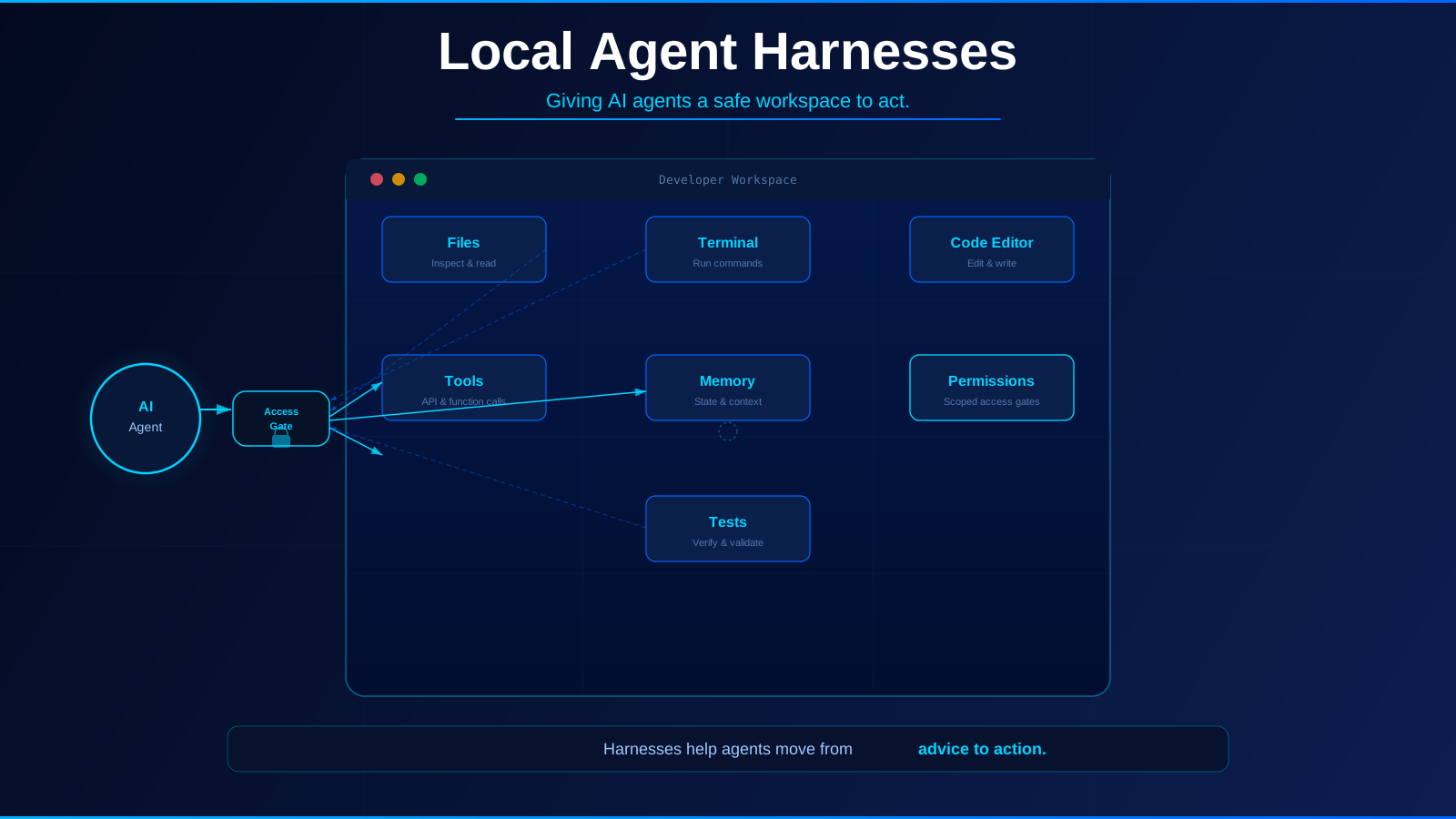
How an Agent Swarm Actually Works
A useful swarm needs more than a large number of agents. It needs design.
Here is the practical architecture.
1. A clear scenario
The swarm needs a specific situation to test.
Weak scenario:
Simulate the market.Better scenario:
Simulate how mid-market SaaS buyers may react if we replace seat-based pricing with usage-based pricing.The second version gives the system a sharper frame. It defines the audience, the change, and the reaction we care about.
2. A shared environment
Agents need a place to act.
That environment could be a simulated social feed, product marketplace, company workflow, support queue, software repository, policy ecosystem, or game world. The environment matters because it decides what agents can see and what actions they can take.
In a social simulation, agents may post, reply, follow, share, or ignore. In a software simulation, they may read files, run tests, open issues, or review code. In a market simulation, they may buy, churn, complain, negotiate, or recommend.
3. Agents with real differences
A swarm is weak if every agent thinks the same way.
Good agents need different roles, incentives, knowledge levels, constraints, and risk tolerance. A skeptical buyer should not behave like an early adopter. A regulator should not behave like a marketer. A competitor should not behave like a support rep.
The point is not to create cartoon personas. The point is to represent meaningful pressure inside the system.
4. Memory and context
Agents need enough context to behave consistently. This may include role instructions, source documents, prior interactions, goals, constraints, market data, product details, and the current state of the environment.
This is where many multi-agent systems become fragile. If agents receive too little context, they behave generically. If they receive too much, the system becomes slow, expensive, and confused. Context engineering is one of the hardest parts of production agent systems.
5. Tools and actions
Agents must be able to do something.
A coding agent may read, edit, and run commands. A market simulation agent may compare plans, ask questions, object, share feedback, or switch vendors. A social simulation agent may post, reply, repost, or follow.
The action layer is what separates a serious simulation from a role-play prompt.
6. Orchestration
Orchestration decides how agents coordinate.
Common patterns include:
- A manager agent assigning tasks to specialists.
- A routing agent handing work to the right agent.
- Parallel subagents researching different areas.
- Debate loops where agents critique each other.
- Graph-based workflows with explicit state.
- A decentralized environment where agents react to events.
OpenAI's agent orchestration documentation describes two broad approaches: letting the LLM decide the next step, or orchestrating the flow in code. Most serious systems mix both.
7. Evaluation and reporting
A swarm is only useful if the result can be inspected.
The final layer should summarize what happened, which patterns appeared, which assumptions were used, what evidence supports the output, and where the simulation may be weak.
Without this layer, the swarm can produce a confident narrative that feels useful but is hard to trust.
Practical Applications of Agent Swarms
Agent swarms are most useful when a decision depends on multiple people, incentives, systems, or feedback loops.
Product launch testing
Before launching a product, a team can simulate reactions from different user groups. Early adopters may care about capability. Skeptical buyers may care about risk. Support teams may see confusion. Competitors may attack the positioning. The simulation can reveal objections before the product reaches the market.
Pricing and packaging changes
Pricing is rarely just a spreadsheet decision. It changes sales conversations, customer trust, competitor positioning, churn risk, and support volume. A swarm can help teams rehearse how different segments might respond.
Market and competitive strategy
Agent swarms can help teams test "what if" scenarios.
What if a competitor launches a cheaper plan?
What if a regulation changes buyer behavior?
What if a new AI feature becomes table stakes?
What if enterprise customers demand more governance?
The output should not be treated as a prediction. It should be treated as a structured way to prepare.
Crisis communication
In a crisis, the problem is not only what happened. The problem is how people interpret it, repeat it, criticize it, and escalate it. A swarm can help communications teams test weak points in a response before it goes public.
Policy and public opinion research
Governments, think tanks, and policy teams can use simulation-style agents to test how different groups may respond to a proposal. This is where OASIS-style work is especially relevant because it focuses on information spread and social behavior.
Software development and engineering teams
In engineering, agent teams can split planning, coding, testing, review, documentation, and security checks. This is not always a swarm in the simulation sense, but it belongs to the same broader movement toward specialized agents.
The best use case is work that can be split clearly and validated. If the task is sequential and fragile, one strong agent may be better.
Synthetic user research
Swarm simulations can help product and marketing teams prepare better questions before speaking to real users. They can test messaging, onboarding, objections, feature concepts, and product positioning.
They should not replace real user research. They should make real research sharper.
The Hard Truth: More Agents Can Make Things Worse
The easiest mistake is assuming that more agents means more intelligence.
It does not.
More agents can create more cost, more latency, more duplicated work, more context fragmentation, and more places for errors to spread. A bad assumption made by one agent can be inherited by the next. A vague instruction can become five different interpretations. A tool failure can be hidden inside a polished final report.
This is why the recent debate around multi-agent systems is becoming more practical. VentureBeat has covered research on the "swarm tax," where multi-agent systems can lose efficiency compared to simpler single-agent setups when compute budgets are equal or when tool-heavy environments create coordination overhead.
The practical rule is simple:
Use one agent when the task is linear.
Use multiple agents when the work can be divided.
Use a swarm when the outcome depends on interaction.
That rule will save teams from a lot of unnecessary architecture.
What Makes an Agent Swarm Useful?
A useful swarm has five qualities.
It has a sharp question
The swarm should answer a specific decision question. The broader the question, the weaker the result.
It has meaningful agent roles
Every agent should represent a real pressure in the system. Avoid adding agents just to make the system look advanced.
It has controlled actions
The environment should limit what agents can see and do. Controlled action spaces make the output easier to inspect.
It has observability
Teams should be able to trace which agent acted, what context it used, what tool it called, and how its action changed the environment.
It keeps humans in the loop
A swarm should support human judgment, not replace it. The output should be reviewed as a hypothesis, not accepted as truth.
Governance Becomes More Important in Swarm Systems
Governance is not a side issue. It becomes more important as soon as multiple agents start acting inside the same environment.
With one agent, you inspect one path.
With many agents, errors can come from coordination problems, context gaps, tool misuse, bad role design, weak evaluation, or hidden assumptions in the scenario. This makes auditability essential.
Teams building agent swarms need:
- Trace logs.
- Permission boundaries.
- Tool-level controls.
- Human approval gates.
- Scenario versioning.
- Source grounding.
- Cost monitoring.
- Evaluation metrics.
- Failure analysis.
- Clear ownership of final decisions.
This is why agent infrastructure is moving toward standards, observability, and management layers. As companies deploy more agents, they will need ways to identify, monitor, govern, and retire them.
A simple way to put it:
The more agents you add, the more governance you need.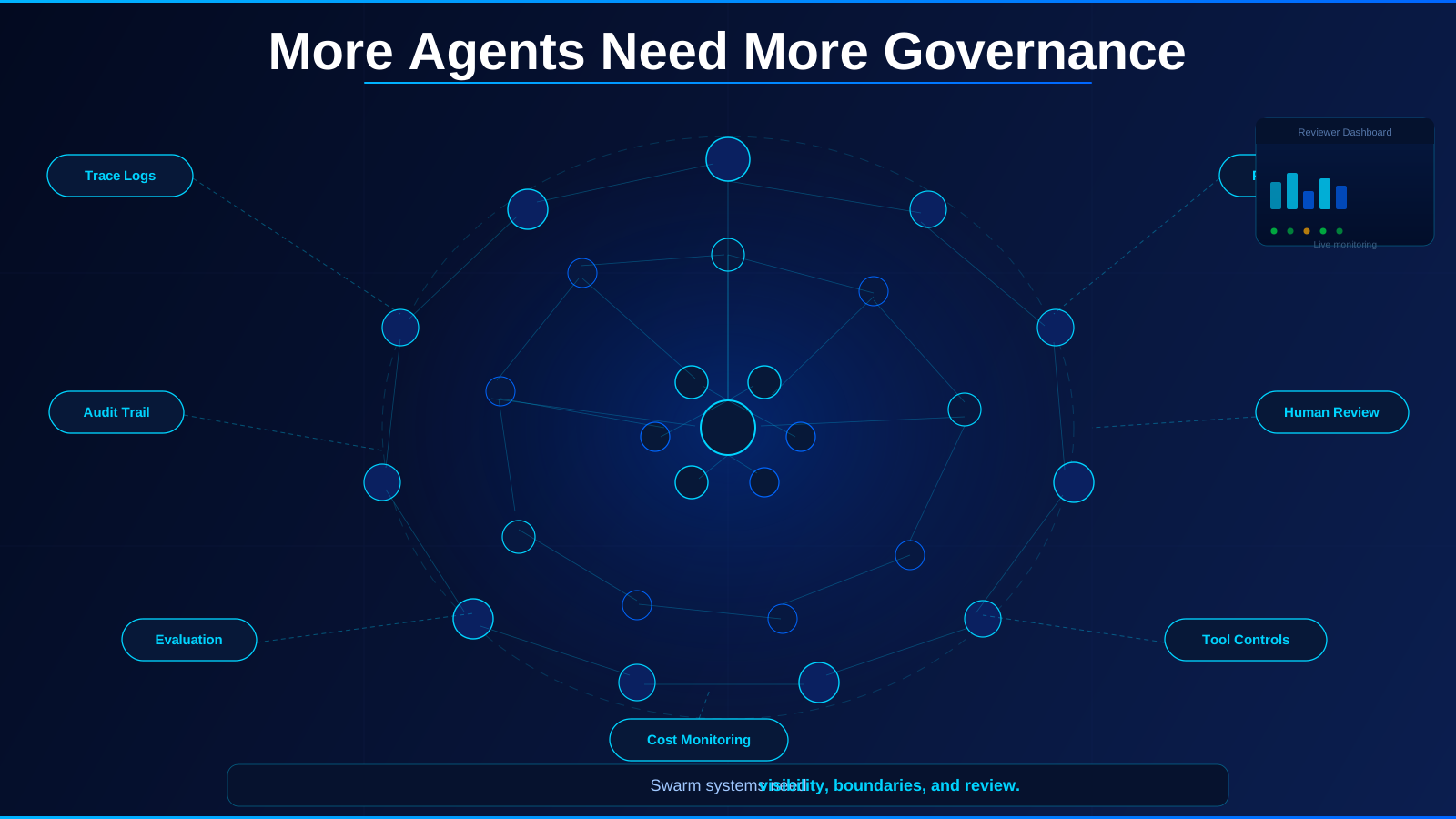
What This Means for Builders and Teams
Agent swarms change the question teams ask about AI.
The old question was:
Can AI complete this task?The new question is:
Can AI help us understand the system around this task?That is a big shift.
Most business decisions do not happen in isolation. A product change affects support. A pricing change affects sales. A public statement affects trust. A new AI workflow affects compliance, security, operations, and user expectations.
Agent swarms give teams a way to rehearse those reactions before the real event.
For product teams, that means testing positioning, onboarding, and objections earlier.
For engineering teams, it means using specialized agents only where the work can be split and validated.
For marketing teams, it means simulating narratives before campaigns go live.
For enterprise teams, it means preparing for a world where many agents operate across systems, but with clear boundaries and review.
The Future: Agents That Execute, Agents That Coordinate, Agents That Simulate
The evolution is becoming clearer.
First, AI answered questions.
What does this code do?Then AI started taking action.
Fix this code and run the tests.Now teams are exploring AI systems that can model interaction.
Simulate how users, competitors, support teams, and regulators may react to this product launch.That third stage is the reason agent swarms matter. They move AI from individual productivity into system-level rehearsal.
They will not replace real users, real markets, real experts, or real accountability. But they can help teams find blind spots earlier. They can expose second-order effects. They can create a safer place to test decisions before they become expensive.
A Better Way to Think About Agent Swarms
Agent swarms are not magic. They are not guaranteed prediction engines. They are not automatically better than single agents.
The best way to think about them is as simulation infrastructure for uncertain decisions.
Single agents help us do work. Multi-agent workflows help us coordinate work. Agent swarms help us rehearse complex reactions.
That is the real shift from task execution to simulation.
The future of AI agents will not be only one assistant doing more tasks. It will include networks of agents that act, react, coordinate, and test possible futures before teams make real-world decisions.