Most SaaS teams still start agent development in the same place: prompts.
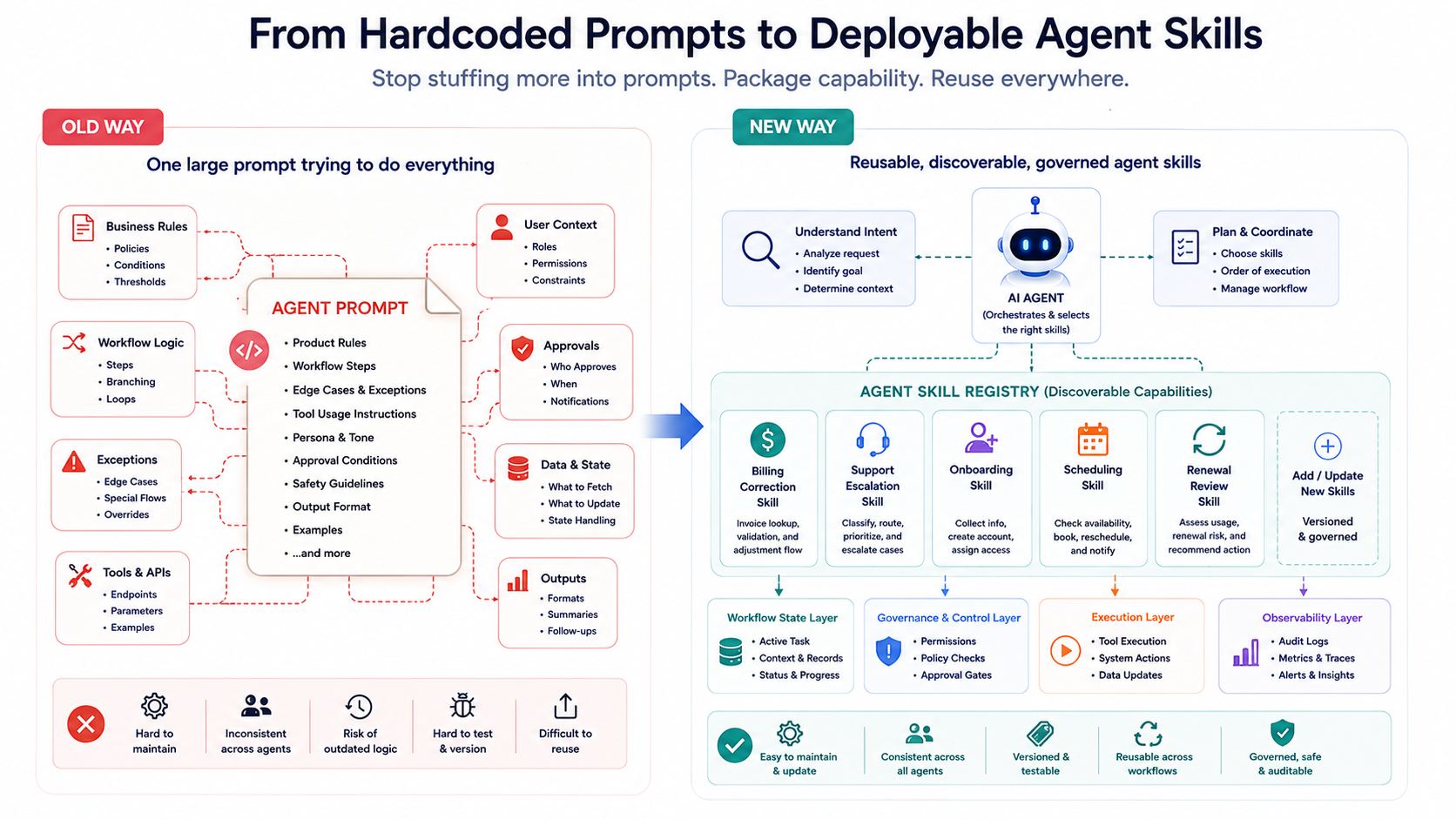
They write instructions, add product rules, connect tools, and keep expanding the prompt as more edge cases appear. This works for a demo. It does not scale well when the agent needs to support real workflows across billing, support, onboarding, scheduling, renewals, or compliance-heavy operations.
A recent Microsoft Agent Framework update points to a better engineering pattern. On July 28, 2026, Microsoft published support for agents to discover and load Agent Skills directly from MCP servers. Instead of packaging every skill inside each app, teams can serve reusable skills centrally and let agents load the right capability when needed.
For agentic SaaS, this matters because the future is not one giant prompt with tools attached. The future is a governed capability layer.
1. Hardcoded Prompts Become Messy When Workflows Grow
A prompt is useful for giving an agent instructions. It becomes fragile when it starts carrying product logic, workflow rules, approval conditions, exception handling, and domain-specific operating knowledge.
That creates a few problems.
The agent becomes harder to update. Small workflow changes require prompt changes across multiple agents. Product rules get mixed with tone, reasoning guidance, and tool instructions. Teams lose track of which agent is using which version of a process.
This becomes risky in SaaS workflows where the same business capability appears in many places.
A billing correction skill may be useful in support, finance, account management, and customer success. An appointment rescheduling skill may be used by patients, providers, admins, and operations teams. A renewal-risk skill may be used by sales, success, and leadership dashboards.
If every agent carries its own copy of that logic, the system becomes inconsistent.
The engineering goal should be to separate reusable domain capability from the agent's general conversation layer.
2. A Skill Registry Turns Domain Work Into Reusable Capability
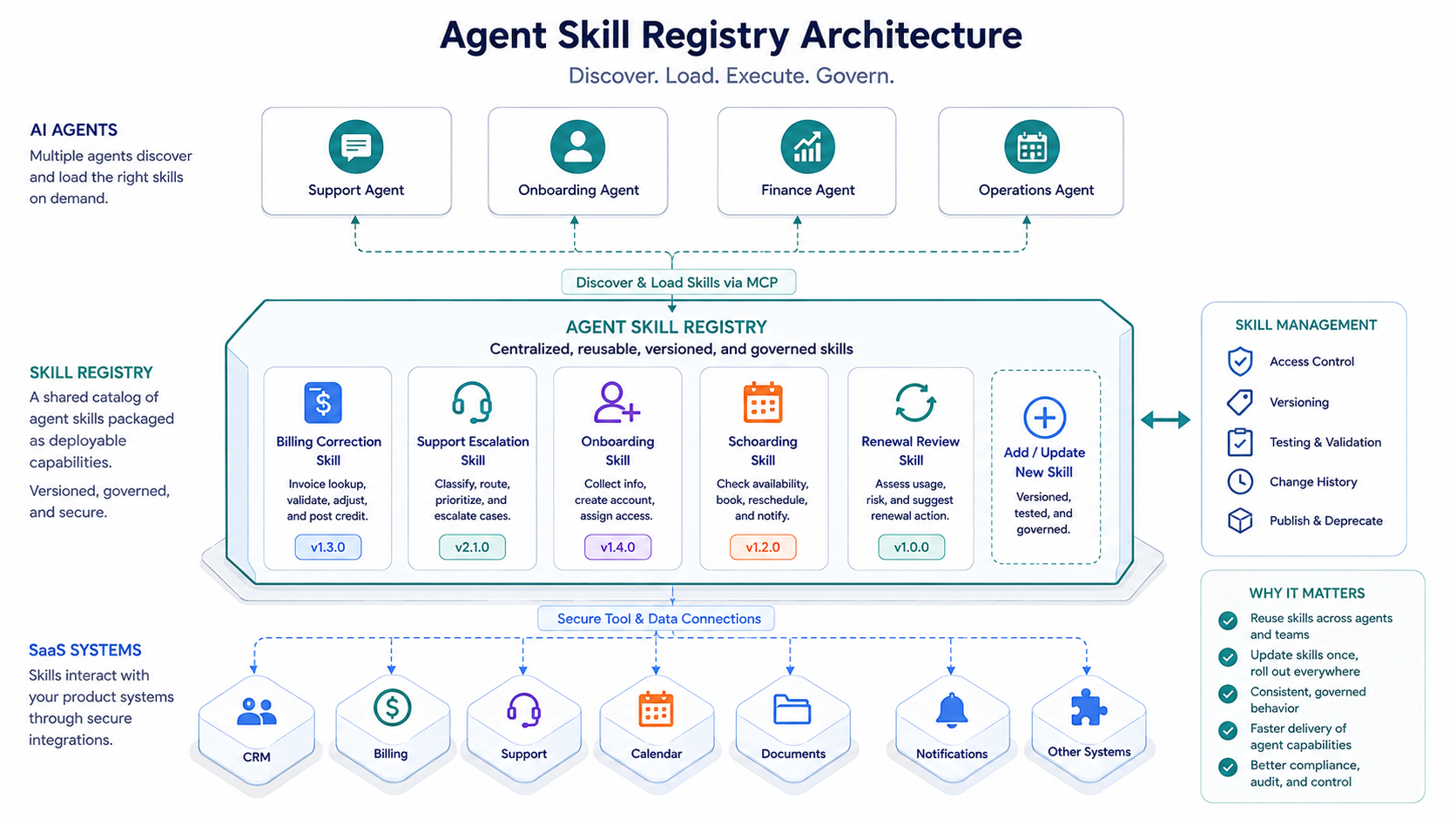
An agent skill is a packaged unit of domain expertise that an agent can discover and use on demand. Microsoft's Agent Skills documentation describes skills as discoverable capability packages, and the MCP-based flow lets servers advertise skills through a discovery document while the framework fetches the required skill content as needed.
That changes the architecture.
Instead of embedding every instruction inside the agent, the product team can define reusable skill packages for specific workflows. Examples include refund review, support escalation, provider scheduling, invoice correction, account provisioning, claim review, or onboarding checklist completion.
This gives engineering teams a cleaner structure:
- The agent handles intent and coordination
- The skill provides domain-specific procedure
- The tool layer exposes callable systems
- The workflow layer tracks state
- The control layer enforces approvals and permissions
The skill registry becomes a shared source of operational capability.
When the process changes, the team updates the skill once. Agents that discover that skill can use the latest approved version without each team manually rewriting their own prompt.
3. Skills Still Need Workflow State and Execution Control
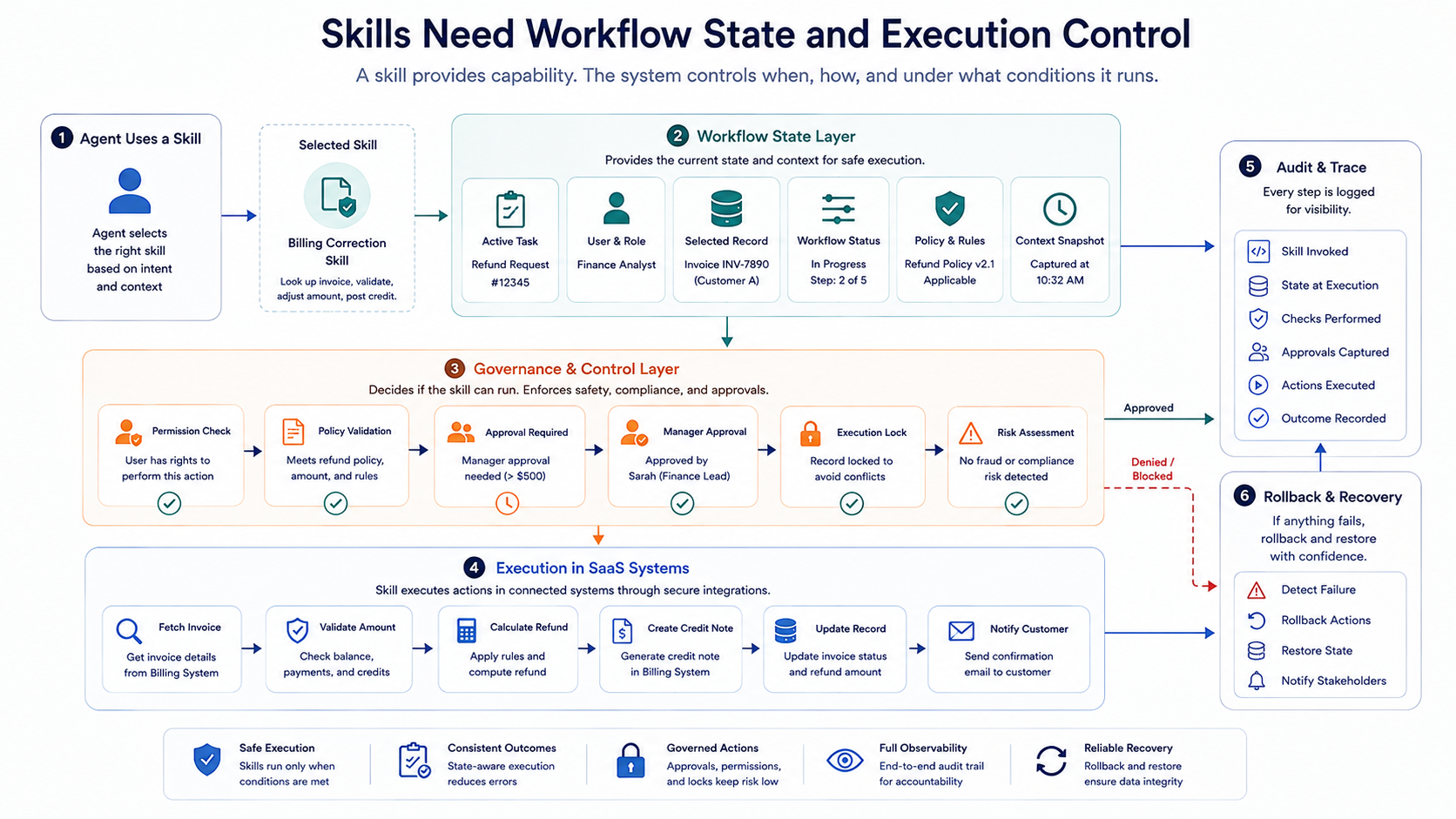
A skill tells the agent how a capability should work. It should not automatically decide whether the agent is allowed to act.
This is the boundary SaaS teams need to design carefully.
A refund review skill may explain how to evaluate eligibility. The product still needs to check user role, account status, payment history, approval threshold, policy exceptions, and rollback rules. A support escalation skill may define the escalation path, but the system still needs to know whether the case is active, who owns it, what SLA applies, and whether a manager approval is needed.
This is why a skill registry cannot replace governance.
The right architecture should place skills inside a broader execution model:
- Skill discovery
- Workflow state
- Permission checks
- Approval gates
- Tool execution
- Audit trail
- Rollback path
A skill gives the agent capability. The control layer decides how that capability can be used.
4. Declarative Workflows Make Skills Easier to Compose
Skills become more powerful when they are combined with declarative workflow definitions.
Microsoft's July 23, 2026 Agent Framework update introduced Declarative Workflows 1.0, where teams can define orchestration in YAML: how agents coordinate, how state changes, where execution branches, and when people step in.
This matters because SaaS workflows are rarely one-step actions.
A customer onboarding workflow may need identity checks, document collection, account setup, permission assignment, welcome communication, and internal review. A support escalation workflow may need severity classification, account history, SLA lookup, approval, ticket update, and customer notification.
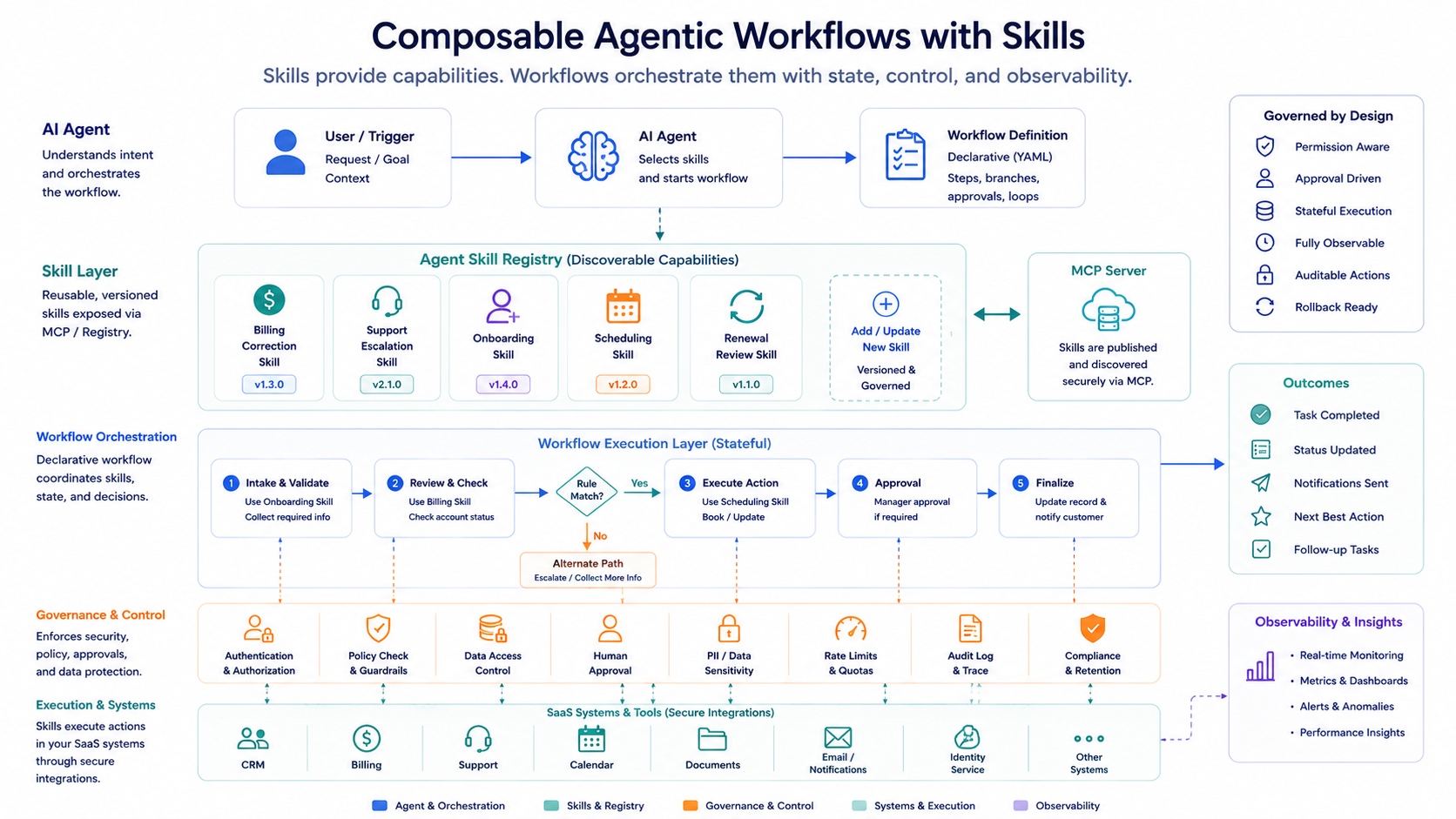
A skill registry provides reusable capabilities. Declarative workflows define how those capabilities fit into a complete process.
This gives SaaS teams a practical architecture pattern:
- Package domain capability as skills
- Expose skills through a governed registry
- Compose them into workflows
- Track state outside the skill
- Control execution through approvals and permissions
- Audit every action and update
At SaaStoAgent, we pay attention to shifts like this because agentic transformation is not about stuffing more instructions into prompts. The real work is turning selected SaaS workflows into reusable, governed, versioned capabilities that agents can safely discover and execute within clear boundaries.