
What Is Agent Harness Engineering?
Agent harness engineering is the practice of designing the runtime environment that makes an AI agent reliable.
A good harness gives the agent:
- The right context at the right time
- A limited set of tools
- Clear permission boundaries
- Durable state and memory
- Validation before risky actions
- Human review where needed
- Full traces of what happened
- Evaluations that catch regressions
- Rollback and recovery paths
That distinction is important. A model can reason probabilistically. A production system needs deterministic controls. The harness is where those controls live.
Why Everyone Is Suddenly Talking About Agent Harnesses
The conversation around agents has moved through three phases. First, teams focused on prompts. Then they focused on context. Now they are realizing that prompts and context are not enough when agents can take action.
OpenAI's harness engineering writeup made this shift concrete. The team described building an internal beta software product with zero manually written code, where every line, including tests, CI configuration, documentation, observability, and tooling, was written by Codex. The lesson was not only that agents could write code. The lesson was that humans had to design environments, specify intent, and build feedback loops so agents could do reliable work.
The same pattern is visible across enterprise platforms. Microsoft's Foundry Control Plane is positioned around observability, guardrails, policy controls, security, evaluations, runtime controls, and fleet governance for AI agents. Google's Agent Development Kit also follows a similar direction, with tools to build, run, evaluate, debug, deploy, and scale agents.
The trend is clear: the industry is moving from "build an agent" to "operate an agent safely."
The Problem: Prompts Are Not Controls
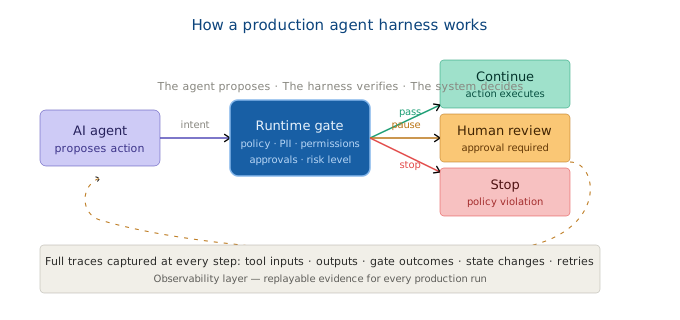
A prompt can ask an agent to be careful. A harness can prevent the agent from doing something dangerous. That difference matters.
If an agent has access to a delete function, a payment API, a production database, or a support escalation workflow, the instruction "only use this when needed" is not enough. The control needs to exist outside the model.
Guardrails, runtime policies, and human approvals decide when an agent run should continue, pause, or stop.
That is harness engineering in practice.
The agent proposes. The harness verifies. The system decides whether execution continues.
The Seven Layers of a Reliable Agent Harness
A production-grade agent harness usually has seven layers.
1. Context Assembly
The harness controls what the agent sees. This includes user intent, account state, retrieved documents, conversation history, permissions, tool descriptions, workflow phase, and any relevant business rules.
Without context control, agents drift. They may hallucinate missing data, reuse stale memory, or make decisions based on incomplete state.
The key is not to give the agent everything. The key is to give it the right context for the current step.
2. Tool Contracts
Every tool should have a strict contract. That means typed inputs, validation, allowed scopes, expected outputs, error handling, and audit logs.
A weak tool contract lets the model pass vague or invented parameters. A strong contract rejects unsafe or malformed calls before they reach the backend.
For SaaS products and workflow platforms, this becomes critical when agents act inside customer accounts. The harness must know which user, role, tenant, object, and permission scope applies before a tool runs.
3. Runtime Gates
Runtime gates decide whether an action should continue. They can check for:
- Policy violations
- PII exposure
- Prompt injection
- Unsafe tool calls
- Missing approvals
- Invalid parameters
- Role mismatch
- High-risk intent
This is one of the biggest differences between a chatbot and an agentic system. A chatbot answers. An agent acts. Anything that acts needs gates.
4. Durable State and Memory
Agents often fail because they lose track of what happened earlier. Durable execution solves part of this problem by saving workflow progress at key points so a process can pause and resume without repeating completed work.
For business workflows, this matters because users do not complete every task in one sitting. They leave, return, change inputs, wait for approval, or move between channels.
The harness should preserve:
- Current workflow phase
- Completed steps
- Pending actions
- Approval status
- Tool outputs
- Memory scope
- Recovery path
Without this layer, agents become fragile in multi-step workflows.
5. Observability and Replay
Traditional monitoring tells you whether the system returned a response. Agent observability tells you how the agent got there.
A reliable harness should capture:
- LLM generations
- Tool calls
- Tool inputs
- Tool outputs
- Guardrail decisions
- State changes
- Human approvals
- Errors and retries
- Final responses
This is where many teams underestimate the problem. When a 20-step agent workflow fails at step 17, the final answer is not enough. You need to know what the agent saw, which tool it called, what came back, which gate passed, where state changed, and why the next step was chosen.
6. Evaluation Loops
A harness should not only record behavior. It should evaluate it. Agent evaluation needs to happen at two levels.
First, evaluate the final outcome. Did the agent complete the user's goal?
Second, evaluate the intermediate steps. Did it choose the right tool? Did it build the right arguments? Did it route to the right sub-agent? Did it escalate when needed?
This is especially important because "the final answer looked fine" can hide serious workflow mistakes.
- An agent may answer politely while calling the wrong API.
- It may summarize correctly while using stale data.
- It may complete a task while skipping a required approval.
- It may appear helpful while increasing operational risk.
The harness should catch these issues before users do.
7. Release and Governance Controls
Reliable agents are not launched once. They are released in controlled stages. A mature harness should support:
- Internal sandbox testing
- Staff-only testing
- Limited customer beta
- Workflow-specific rollout
- Monitoring thresholds
- Rollback criteria
- Incident review
- Regression suites
- Versioned prompts and tools
- Audit logs for compliance
For high-impact systems, governance is not paperwork. It is part of the runtime.
Agent Harness Engineering vs Context Engineering
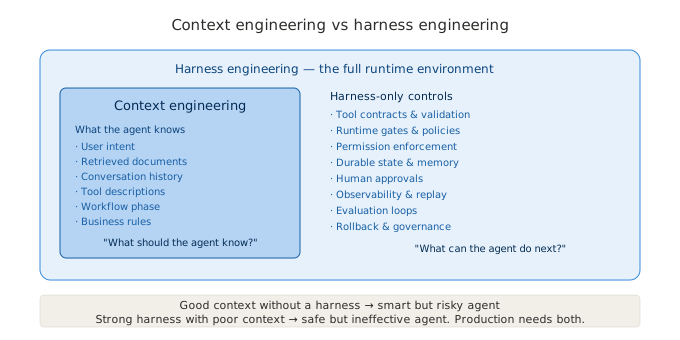
Context engineering is part of harness engineering, but they are not the same.
Context engineering controls what the model sees. Harness engineering controls the full environment in which the model operates.
In simple terms:
- Context engineering asks: "What should the agent know right now?"
- Harness engineering asks: "What should the agent be allowed to do next, and how do we verify it?"
Both are necessary. A good context pipeline without a harness creates a smart but risky agent. A strong harness with poor context creates a safe but ineffective agent. Production systems need both.
What Usually Breaks Without a Harness
Most agent failures are not random. They usually fall into predictable categories.
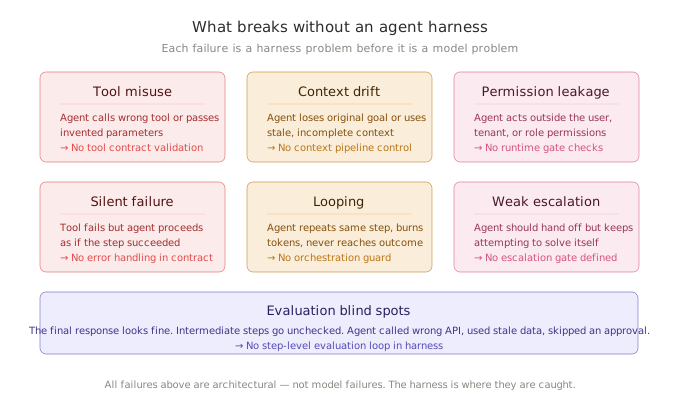
Tool Misuse
The agent calls the wrong tool, calls a tool too early, or passes invented parameters.
Context Drift
The agent loses the original goal, overuses stale memory, or makes decisions from incomplete context.
Permission Leakage
The agent performs an action that the current user, tenant, or role should not be allowed to perform.
Silent Failure
A tool fails, but the agent continues as if the operation succeeded.
Looping
The agent repeats the same step, burns tokens, and never reaches a stable outcome.
Weak Escalation
The agent should hand off to a person but keeps trying to solve the problem itself.
Evaluation Blind Spots
The final response is judged, but the intermediate steps are ignored.
Each of these is a harness problem before it is a model problem.
How to Build an Agent Harness for a Real Product
Start narrow. Do not try to build a general-purpose agent first.
Pick one workflow where the agent can create measurable value and where failure is understandable. Good candidates include onboarding, support triage, report generation, appointment booking, internal knowledge retrieval, invoice review, or workflow automation.
Then design the harness around that workflow.
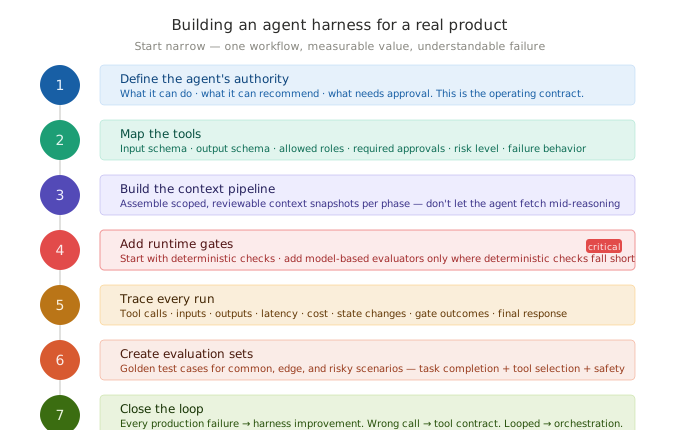
Step 1: Define the Agent's Authority
Write down what the agent can do, what it can recommend, what it can execute, and what needs approval. This becomes the agent's operating contract.
Step 2: Map the Tools
List every tool the agent can call. For each tool, define:
- Input schema
- Output schema
- Allowed user roles
- Required approvals
- Risk level
- Logging requirements
- Failure behavior
Step 3: Build the Context Pipeline
Define what context is injected at each phase. Do not rely on the agent to fetch everything mid-reasoning. The harness should assemble a scoped, reviewable context snapshot.
Step 4: Add Runtime Gates
Create gates before sensitive actions. Start with simple deterministic checks, then add model-based evaluators only where deterministic checks are not enough.
Critical step: Runtime gates are where the harness earns its value. This is the layer that separates a demo agent from a production agent. Do not skip it.
Step 5: Trace Every Run
Capture tool calls, tool inputs, tool outputs, latency, cost, state changes, gate outcomes, and final response. The goal is not dashboards for the sake of dashboards. The goal is replayable evidence.
Step 6: Create Evaluation Sets
Build golden test cases for common, edge, and risky scenarios. Evaluate:
- Final task completion
- Tool selection
- Parameter correctness
- Escalation behavior
- Refusal behavior
- Safety compliance
- Cost and latency
Step 7: Close the Loop
Every production failure should become a harness improvement.
- If the agent made a wrong call, update the tool contract.
- If it lacked information, update the context pipeline.
- If it skipped approval, update the gate.
- If it looped, update orchestration.
- If the issue was not caught, update the eval suite.
That is the core loop of harness engineering.
Practical Metrics for Agent Harness Quality
A reliable harness should make quality measurable. Useful metrics include:
Avoid measuring only response quality. Agentic systems fail inside the workflow, not just in the final answer.
Common Mistakes Teams Should Avoid
Mistake 1: Treating the Prompt as the Safety Layer
The prompt can guide behavior. It cannot enforce control. Safety must live in runtime gates, permissions, schemas, and approvals.
Mistake 2: Giving the Agent Too Many Tools
More tools do not always mean more capability. They often mean more confusion. Start with the smallest useful toolset.
Mistake 3: Logging Only the Final Answer
The final answer is the least useful artifact when debugging an agent. You need the path, not just the output.
Mistake 4: Evaluating Only Happy Paths
Most demos test ideal users. Production systems face unclear intent, incomplete data, role mismatch, adversarial inputs, timeouts, and tool failures.
Mistake 5: Skipping Human Review Design
Human-in-the-loop is not a modal window added at the end. It is part of the workflow architecture. The system must know when to pause, what evidence to show, what decisions are allowed, and how to resume after review.
Why This Matters for Modern Software Products
Software is moving from static interfaces to agentic workflows. Users will not always click through dashboards, filters, settings, and reports. Increasingly, they will ask the product to do the work.
That changes the product architecture:
- A traditional interface exposes features.
- An agentic system executes intent.
- Execution requires control.
Agent harness engineering becomes the bridge between product UX and backend safety. It lets an agent operate across existing APIs, permissions, business rules, workflows, and data boundaries without turning every release into a trust risk.
This is especially important for products with:
- Multi-tenant data
- Role-based access
- Complex workflows
- Regulated users
- Sensitive actions
- Long-running tasks
- External integrations
- Audit requirements
In these environments, the question is not "Can we add an AI agent?"
The better question is: Can we build the control layer that lets the agent act safely inside our product?
Final Takeaway
The next phase of AI agents will not be won only by the team using the strongest model. It will be won by the team with the strongest control layer.
Agent harness engineering is how AI agents become dependable enough to work inside real products, real teams, and real customer workflows.
For companies moving toward agentic products, this is the architectural shift to understand now:
The agent is not the product. The governed agent runtime is the product.