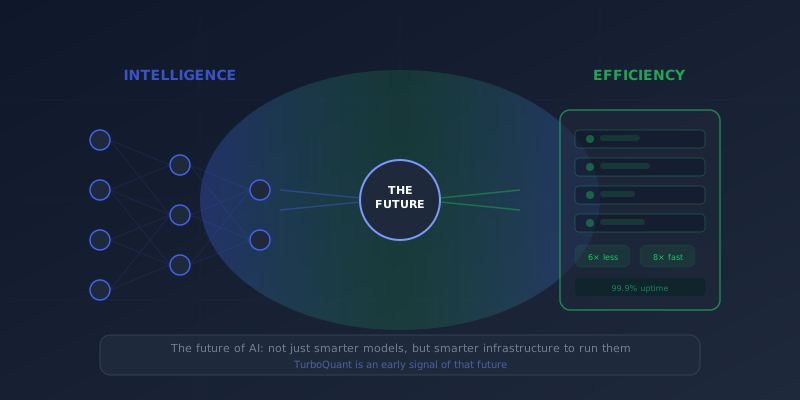
Most people follow AI through headlines about new models. Bigger context windows. Better reasoning. More human-like conversation.
But some of the most important advances in AI do not look flashy at first. They happen lower in the stack, inside the infrastructure that makes those systems affordable, responsive, and scalable.
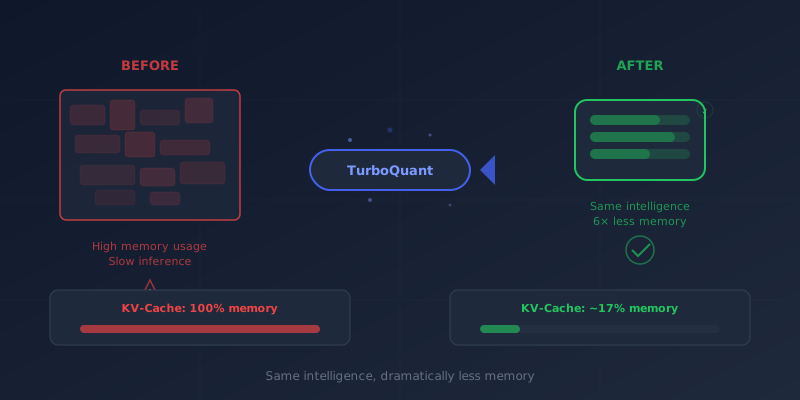
TurboQuant is one of those advances. Google Research recently introduced it as a compression method aimed at one of the less visible but increasingly expensive parts of modern AI systems: memory used during inference, especially key-value cache and vector-heavy workloads. Google says TurboQuant can reduce KV-cache memory by 6× or more and improve attention speed by up to 8× on H100 GPUs, while preserving model accuracy and without retraining.

What TurboQuant actually is
In simple terms, TurboQuant is a way to compress the internal data structures that AI systems use while they are working. Google positions it as a training-free compression approach for high-dimensional vectors, especially for two important areas: KV-cache compression for large language models and vector search for retrieval-heavy systems.
That may sound technical, but the practical meaning is straightforward. AI systems constantly store and reuse information while generating responses. The more context they carry, the more memory they consume. TurboQuant is designed to shrink that memory burden without meaningfully hurting output quality. Google says it does this through methods called PolarQuant and Quantized Johnson-Lindenstrauss, which together reduce the usual overhead that comes with vector quantization.
Why this matters more than it first appears
AI is entering a stage where raw model quality is only part of the story. The real challenge is making powerful systems practical to run.
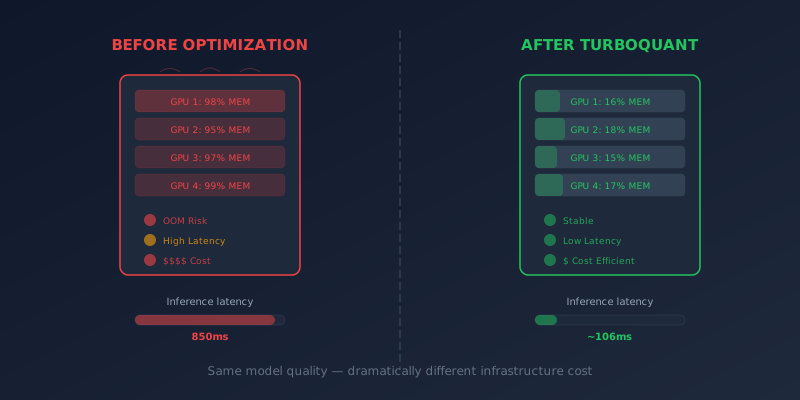
As models take in longer documents, longer conversations, more retrieved knowledge, and more tool outputs, inference becomes expensive. Memory use grows quickly, and that creates cost, latency, and hardware bottlenecks. Google's framing for TurboQuant is important because it targets that exact pressure point. Instead of asking how to build a smarter model from scratch, it asks how to make existing systems work far more efficiently.
This is why I think optimizations like TurboQuant may become strategically important. In the next phase of AI, winners will not only be the companies with strong models. They will also be the companies that can deliver strong AI experiences at sustainable cost and speed. That conclusion is partly an inference, but it follows directly from the memory and performance gains Google is claiming.
How this could help ordinary AI products
For the general public, the benefit is not "better compression" in the abstract. The benefit is what that compression enables.
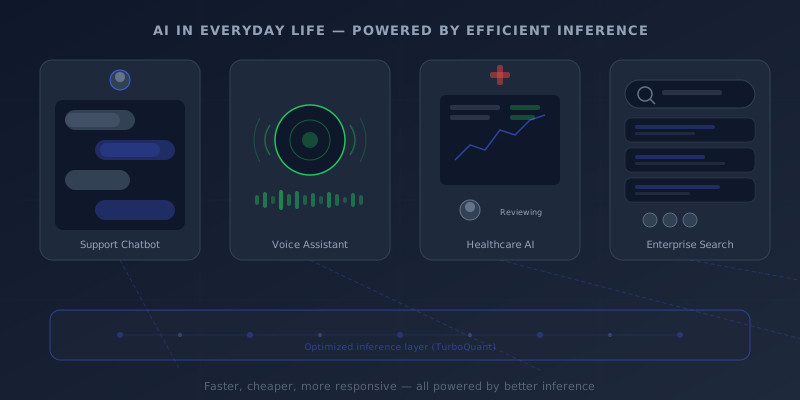
It could mean chatbots that stay fast even during long conversations. It could mean voice assistants that respond more naturally because the backend is carrying less memory burden. It could mean enterprise AI systems that can search more knowledge, remember more context, and still stay financially viable. Because Google also ties TurboQuant to vector search, the implications extend beyond chat into retrieval, recommendation, semantic search, and memory-heavy AI products.
This matters because many useful AI products are no longer simple question-answer systems. They are increasingly combinations of memory, search, retrieval, tool use, and reasoning. Any technique that reduces the cost of that stack can improve the user experience indirectly.
Where TurboQuant could matter most in the future
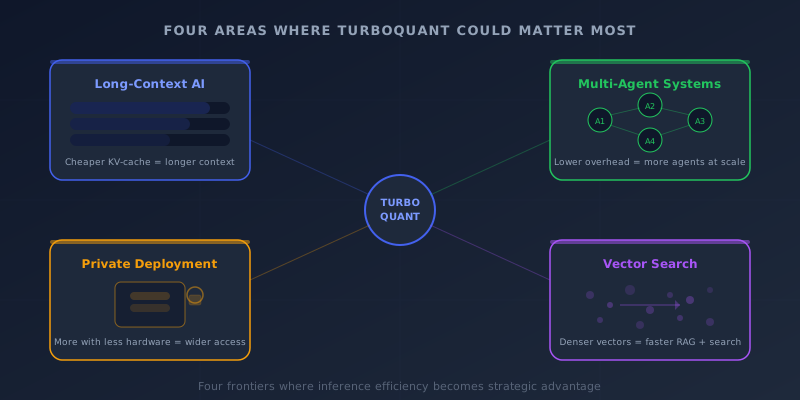
The biggest long-term impact may show up in four places.
First, long-context AI. If memory becomes cheaper, it becomes easier to run systems that can hold more conversation history, more retrieved documents, and more working context at once. Google explicitly presents TurboQuant as a way to ease KV-cache bottlenecks in long-context inference.
Second, multi-agent systems. When multiple AI components work together, memory and inference load rise quickly. TurboQuant was not introduced as a "multi-agent tool" specifically, but lower inference overhead could make those architectures more practical to operate at scale. This is an inference rather than a direct vendor claim.
Third, private and cost-sensitive deployments. If teams can do more with the same hardware, strong AI systems become more reachable for organizations that cannot spend endlessly on GPUs. That is one of the most commercially interesting implications of any serious inference optimization.
Fourth, retrieval-heavy software. Because Google is positioning TurboQuant for vector search as well as KV-cache compression, future RAG systems, enterprise search products, and AI memory layers may all benefit from denser and cheaper vector operations.
What business leaders should understand right now
The key takeaway is this: not every major AI breakthrough will look like a new chatbot.
Some of the most valuable shifts will be about efficiency, reliability, and economics. TurboQuant looks like part of that trend. It suggests a future where progress is not only about training bigger models, but about serving models more intelligently.
Business leaders do not need to understand the math behind vector quantization. They do need to understand the strategic pattern. If AI systems can become faster and cheaper to run without sacrificing quality, that changes product design, operating cost, and what becomes commercially feasible.

A note of caution
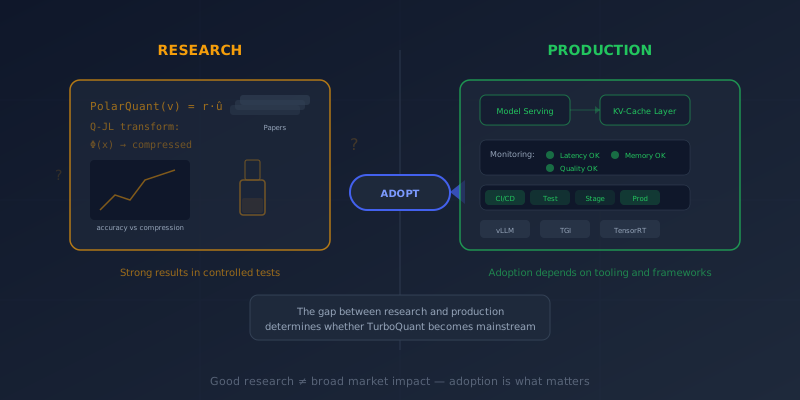
TurboQuant is promising, but it is still new. Google has announced strong results, and outside coverage has echoed the main headline numbers, but the bigger question is how widely these methods will be adopted across model-serving stacks and real production workflows. That adoption curve will determine whether TurboQuant becomes a mainstream optimization or remains mostly a research milestone.
That is an important distinction. In AI, a good research result is not automatically the same as broad market impact. The market impact comes when tooling, frameworks, and deployment practices catch up.
Final thought
TurboQuant may not become a household name. But the kind of progress it represents is exactly what will shape the next generation of AI products.
The future of AI will not be decided only by who has the most powerful model. It will also be decided by who can make that power efficient, scalable, and usable in the real world. TurboQuant is an early signal of that future.