
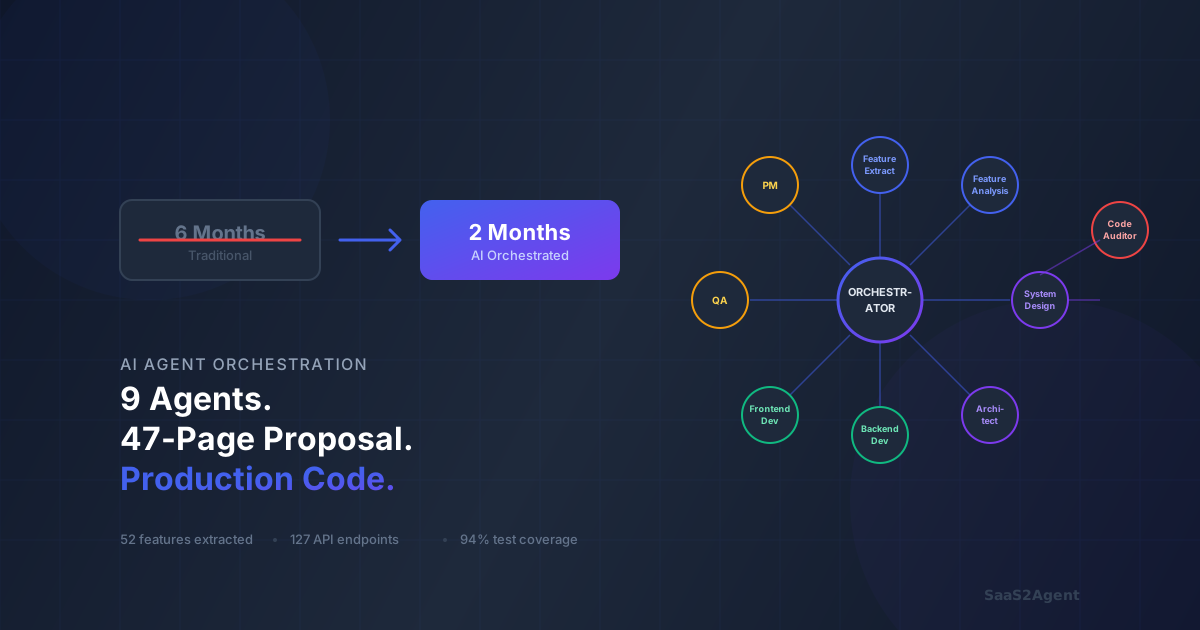
The Breaking Point: Why Traditional Development Fails at Scale
A few months back, we received a 47-page PDF proposal for building a marketplace platform connecting customers with service providers. The client wanted a complete solution: mobile app, website, backend APIs, admin dashboard, payment integration, and deployment-ready code. Timeline: 6 months. Budget: Fixed.
I stared at that PDF and felt the familiar dread. Here's what I knew would happen:
- Week 1–3: Manual proposal analysis, extracting basic requirements into spreadsheets/docs/pdf/md files.
- Week 4–6: Shallow feature analysis, missing critical technical details
- Week 7–9: Architecture meetings with incomplete specifications, endless revisions
- Week 10–12: Scope creep from undiscovered technical requirements and edge cases
- Week 13–18: Backend development starts with unclear specs, frontend waits for API definitions
- Week 19–22: Integration hell as missing requirements surface during development
- Week 23–26: Frantic bug fixes, scope expansion, delayed delivery, budget overrun
This cycle had burned us before. The root cause? Inadequate upfront analysis. Traditional development treats requirements gathering as a quick checkbox exercise, but proper feature analysis — understanding technical implications, database relationships, API contracts, and integration points — is where most projects fail.
That's when we decided to build something different: a multi-agent orchestration system that could take a PDF proposal and automatically generate production-ready code.
What Multi-Agent Orchestration Actually Means
Forget the buzzwords. Multi-agent orchestration is simply this: specialized AI workers collaborating on a shared project with human oversight at critical decision points.
Think of it like a construction project. You don't have one person doing everything. You have:
- An architect who designs the structure
- A project manager who creates timelines
- Specialized service providers (contractors for electrical, plumbing, and framing)
- Quality inspectors who validate work
- A general contractor who coordinates everything
Our software development system works the same way, but with AI agents:
The 9-Agent Development Team
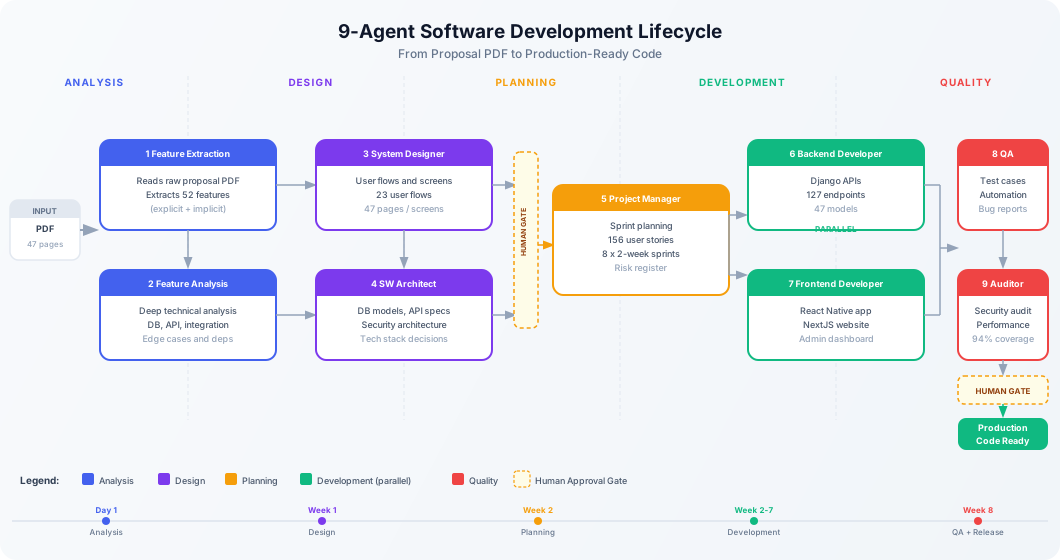
1. Feature Extraction Agent
- Role: Requirements analyst
- Input: Raw proposal PDF/DOCX
- Output: Structured feature list (extracted 52 features from my 47-page proposal)
- Why needed: Humans miss implicit requirements. This agent finds explicit features ("user login") and implicit ones ("password reset", "session management")
2. Feature Analysis Agent
- Role: Technical business analyst
- Input: Feature list from extraction
- Output: Deep technical analysis per feature with database implications, API requirements, and integration points
- Why critical: This is where most projects fail. Traditional development does shallow analysis ("user can login") but misses technical depth ("login requires password reset flow, session management, role-based redirects, OAuth integration, account lockout policies"). This agent prevents the scope creep and integration hell that destroys timelines.
3. System Designer Agent
- Role: UX architect
- Input: Analyzed features
- Output: User flows, page inventory, interaction patterns
- Why needed: Prevents UI/UX inconsistencies and ensures logical user journeys
4. Software Architect Agent
- Role: Technical architect
- Input: System design, features
- Output: Database models, API specifications, security design
- Why needed: Creates the technical foundation that everything else builds on
5. Project Management Agent
- Role: Scrum master
- Input: Architecture, features
- Output: Sprint plans, backlog, timeline, risk assessment
- Why needed: Breaks work into manageable chunks with realistic timelines
6. Backend Developer Agent
- Role: Server-side developer
- Input: Architecture, sprint plans, feature specs
- Output: Django APIs, database migrations, business logic
- Why needed: Implements server-side functionality following architectural decisions
7. Frontend Developer Agent
- Role: Mobile/web developer
- Input: API specs, UI designs, feature requirements
- Output: React Native mobile app, Website, and Admin Dashboard
- Why needed: Builds user-facing applications that consume backend APIs
8. QA Tester Agent
- Role: Quality assurance engineer
- Input: Implemented features, acceptance criteria
- Output: Test cases, automation scripts, bug reports
- Why needed: Validates that features work correctly before release
9. Code Auditor Agent
- Role: Security/performance reviewer
- Input: Complete codebase, QA reports
- Output: Security audit, performance analysis, code quality report
- Why needed: Ensures production readiness and identifies potential issues
The Real Challenges (And How I Solved Them)
Challenge 1: State Management Nightmare
Problem: With 9 agents working sequentially, how do you track what's completed, what's in progress, and what failed? Traditional project management tools don't work for AI agents.
My Solution: Comprehensive state tracking system
{
  "current_stage": 4,
  "completed_stages": [1, 2, 3],
  "failed_stages": [],
  "pending_approval": "architecture_review",
  "started_at": "2024-01-15T10:00:00Z",
  "last_updated": "2024-01-15T14:30:00Z"
}
Every action is logged in an append-only audit trail:
{"ts": "2024-01-15T14:30:00Z", "stage": "architecture", "action": "approved",
"by": "vivek@company.com", "artifacts": ["architecture-overview.md",
"api-spec.yaml"]}
Result: Perfect resumability. If something fails at stage 6, I can fix it and continue from exactly where I left off.
Challenge 2: Quality Control Without Human Micromanagement
Problem: AI agents can produce garbage if not properly guided. But reviewing every output defeats the purpose of automation.
My Solution: Strategic approval gates at critical junctions
- Architecture Approval: Human reviews system design before any coding starts
- Project Plan Approval: Human validates timeline and scope before implementation
- Release Approval: Human signs off on the security audit before production deployment
Result: 3 human touchpoints instead of constant supervision, but quality remains high.
Challenge 3: Agent Context Preservation
Problem: Later agents need to understand decisions made by earlier agents. How does the QA agent know why the architect chose PostgreSQL over MongoDB?
My Solution: Structured documentation contracts
- Each agent produces standardized outputs in predefined locations
- Shared
/decisions.mdfile logs all major technical decisions with rationale - OpenAPI specification serves as the contract between frontend and backend agents
Traditional Development Problem: Teams jump from basic requirements to architecture without proper feature analysis. Result: 60% of development time spent on "unexpected" requirements that should have been identified upfront.
Multi-Agent Solution: Feature Analysis Agent spends focused time on each feature, documenting:
- Technical complexity and dependencies
- Database schema requirements
- API endpoint specifications
- Integration touchpoints
- Security and performance implications
- Edge cases and error scenarios
This prevents the classic "we didn't know we needed that" conversations that derail projects.
Challenge 4: Parallel vs Sequential Execution
Problem: Some work can happen in parallel (frontend + backend), but other work must be sequential (architecture before coding).
My Solution: YAML-defined pipeline with dependency management
- id: 7
  name: "codegen"
  type: "ai_agent_parallel"
  parallel: true
  agents: ["backend-developer", "frontend-developer"]
  requires: [6] # Must complete project planning first
Result: Frontend and backend development happen simultaneously using the shared API contract, cutting development time in half.
My Implementation: A Real Project Case Study
Let me walk you through exactly what happened when we fed that 47-page proposal into my system:
Stage 1–3: Automated Analysis (1 day)
# Input: proposal.pdf (47 pages)
python3 pipeline/pipeline.py run
Feature Extraction Agent Output:
- 52 features identified (17 explicit from proposal + 35 implicit technical requirements)
- Features categorized by priority: 18 Critical, 20 High, 10 Medium, 4 Low
- Dependencies mapped (e.g., "Payment Processing" requires "User Authentication")
Feature Analysis Agent Output:
- Each feature was analyzed for technical complexity
- Acceptance criteria defined
- Edge cases identified (e.g., "What happens if payment fails during booking?")
- Integration points documented
Stage 4: System Design (2 days with AI agent)
System Designer Agent Output:
- 23 unique user flows mapped
- 47 pages/screens identified across the mobile and admin dashboard
- User role permissions defined (Customer, Provider, Admin)
- Navigation patterns standardized
Stage 5: Architecture Design (3 days with AI agent)
Software Architect Agent Output:
- Complete database schema (15 models, 47 fields)
- Security architecture (JWT auth, role-based access, API rate limiting)
- Technology stack decisions with rationale
Key Architectural Decisions for the Project:
- Django + PostgreSQL for backend (scalability, admin interface)
- React Native + Expo for mobile (cross-platform, rapid development)
- NextJS for the website and Zustand for managing client-side global state
- Redis for caching and session management
- Celery for background tasks (email sending, payment processing)
Stage 6: Project Planning (2 days with AI agent)
Project Management Agent Output:
- 8 two-week sprints planned
- 156 user stories created and prioritized
- Risk register with mitigation strategies
- Release plan with 3 major milestones
Sprint Breakdown:
- Sprint 1–2: Authentication, user profiles, basic navigation
- Sprint 3–4: Service listings, search, booking system
- Sprint 5–6: Payments, notifications, reviews
- Sprint 7–8: Admin features, testing, deployment
Stage 7: Code Generation (6 weeks with AI agents)
This is where the magic happened. Both agents worked (we run it sequentially for MVP, and it can be run in parallel, but some modification or tracing is required for implementation):
Backend Developer Agent:
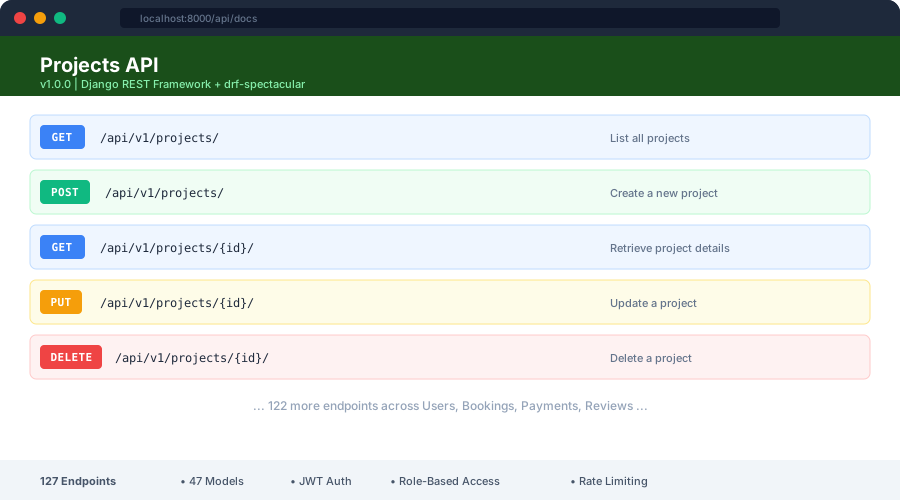
- Generated 47 Django models with proper relationships
- Implemented 127 API endpoints matching the OpenAPI spec
- Created database migrations and seed data
- Added comprehensive input validation and error handling
- Implemented JWT authentication and role-based permissions
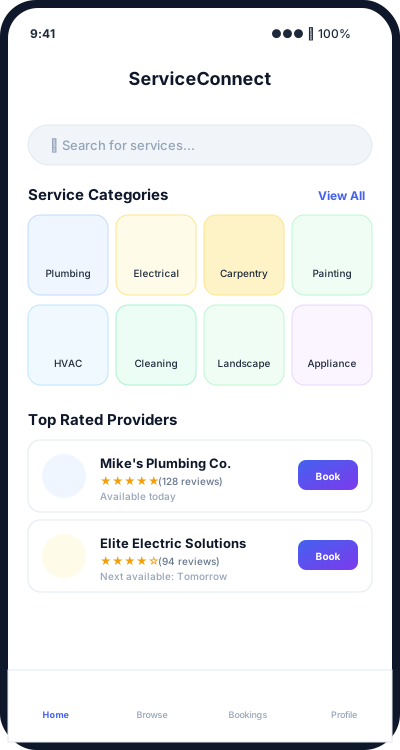
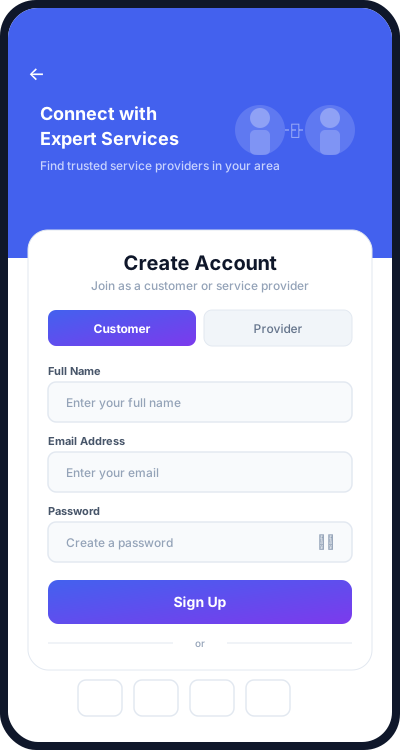
Frontend Developer Agent:
- Built screens with proper navigation
- Implemented state management using Zustand
- Created reusable UI components following the design system
- Added form validation and error handling
- Integrated with backend APIs using generated TypeScript types
Parallel Development Benefits:
- Frontend used mock APIs (generated from OpenAPI spec) during development
- Backend implemented real APIs matching the contract
- Integration required minimal changes (just swapping mock URLs)
Total development time: 6 weeks instead of 12 weeks sequential
Stage 8–9: Quality Assurance (1 week)
QA Tester Agent Output:
- Test cases covering all acceptance criteria
- Performance benchmarks and load testing scenarios
Code Auditor Agent Output:
- Security audit: No critical vulnerabilities found
- Performance analysis: All API endpoints under 200ms response time
- Code quality: 94% test coverage, consistent coding standards
- Deployment readiness: Docker containers, CI/CD pipeline configured
The Results: 6 Months → 2 Months
Time Breakdown:
- Analysis & Design: 1 week (vs 9 weeks traditional)
- Development: 6 weeks (vs 12 weeks traditional)
- Testing & QA: 1 week (vs 4 weeks traditional)
- Deployment Prep: 3 days (vs 1 week traditional)
Quality Metrics:
- ✅ 94% test coverage (vs typical 60–70%)
- ✅ Zero critical security vulnerabilities
- ✅ All 52 features implemented with acceptance criteria met
- ✅ Complete documentation and API specs
- ✅ Production-ready deployment configuration
Implementation Guide: How You Can Build This
Step 1: Define Your Pipeline
Create a pipeline.yaml that defines stages, dependencies, and approval gates:
stages:
  - id: 1
    name: "feature_extraction"
    agent: "feature-extraction"
    type: "automated"
    script: "extract_features.py"

  - id: 2
    name: "architecture_design"
    agent: "software-architect"
    type: "ai_agent"
    requires: [1]
    on_success: "request_approval"
Step 2: Build State Management
Track progress in JSON files that agents can read/write:
def save_pipeline_state(self):
    self.state['last_updated'] = datetime.now().isoformat()
    with open('_state/pipeline-state.json', 'w') as f:
        json.dump(self.state, f, indent=2)
Step 3: Create Agent Prompts
Each agent needs a detailed prompt defining inputs, outputs, and quality standards:
# Software Architect Agent Prompt

## Role
You are a senior software architect designing production systems.

## Inputs
- proposal/proposal.md
- features/*.md
- agents/feature-analysis/outputs/*.md

## Outputs
- architecture-overview.md
- system-components.md
- data-model.md
- api-guidelines.md
- _shared/openapi.yaml

## Quality Standards
- All APIs must follow RESTful conventions
- Database schema must be normalized
- Security requirements are non-negotiable
Step 4: Implement Validation
Validate that agents produce expected outputs:
def validate_outputs(self, stage):
    outputs = stage.get('outputs', [])
    missing = []

    for output_pattern in outputs:
        if not Path(output_pattern).exists():
            missing.append(output_pattern)

    return len(missing) == 0
Step 5: Add Human Approval Gates
Pause at critical points for human review:
def run_approval_gate(self, stage):
    print(f"APPROVAL REQUIRED: {stage['name']}")
    response = input("Approve this stage? (yes/no): ")
    return response.lower() == 'yes'
Lessons Learned: What Works and What Doesn't
What Works Brilliantly
- Contract-First Development: Generating the OpenAPI spec early enables true parallel development. Frontend and backend teams never block each other.
- Feature-by-Feature Implementation: Building one complete feature (backend + frontend + tests) before moving to the next ensures you always have working software.
- Structured Agent Outputs: Forcing agents to produce outputs in specific formats and locations ensures seamless handoffs.
- Strategic Approval Gates: 3 human touchpoints (architecture, plan, release) provide sufficient quality control without micromanagement.
What Needs Improvement
- Context Window Limitations: Large projects can exceed AI context limits. Solution: Break features into smaller sub-features.
- Agent Hallucination: Agents sometimes claim to complete tasks they didn't actually do. Solution: Rigorous output validation.
- Error Recovery: When agents fail, restarting from scratch wastes time. Solution: Implement checkpoint/resume functionality.
- Cost Management: Running 9 AI agents isn't cheap. Solution: Use smaller models for simple tasks, reserve powerful models for complex work.
The Future of Software Development
This isn't just about AI replacing developers. It's about amplifying human creativity by automating the repetitive, error-prone parts of software development.
What gets automated:
- Requirements extraction and analysis
- Documentation writing
- Boilerplate code generation
- Test case creation
- Configuration management
What stays human:
- Creative problem solving
- Business logic decisions
- User experience design
- Strategic technical choices
- Quality judgment calls
The developers who thrive in this future won't be the ones who can write the most code. They'll be the ones who can orchestrate AI agents effectively and make high-level decisions that shape the product.
Getting Started: Your Next Steps
- Start Small: Pick a simple project (todo app, blog) and build a 3-agent pipeline (architect → developer → tester)
- Focus on State Management: Get the pipeline mechanics right before adding more agents
- Invest in Prompts: 80% of success comes from well-crafted agent prompts with clear inputs/outputs
- Add Validation: Agents will lie about completing work. Always validate outputs exist and meet quality standards
- Iterate on Approval Gates: Start with more human oversight, reduce as you gain confidence in agent outputs
The future of software development is orchestrated, automated, and human-guided. The question isn't whether this approach will become standard — it's how quickly you'll adopt it to stay competitive.
Ready to build your own multi-agent development system? The code, prompts, and pipeline definitions from this project are available as a reference implementation. Start with a simple project and gradually add more agents as you learn what works.
The age of manual software development is ending. The age of orchestrated development has begun.