
For the past few years, most AI applications have followed a familiar pattern: a user sends a prompt, a language model generates text, and the application decides what to do with that output. While this paradigm enabled powerful conversational systems, it has also exposed a limitation. Language models could reason about tasks, but could not directly interact with the digital environment where those tasks actually occur.
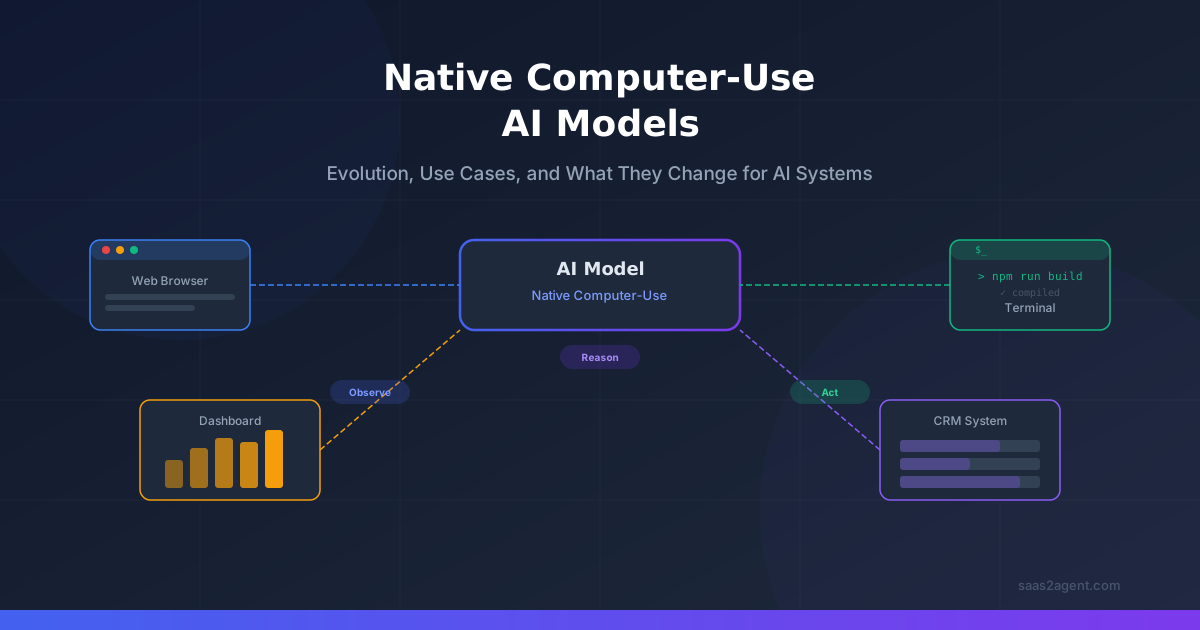
A new class of models is beginning to change this limitation. These are AI models with native computer-use capabilities, models that can observe interfaces, interact with software, and perform actions across applications in ways that resemble human computer usage.
Recent model releases, including the latest GPT 5.4 model, have increasingly focused on enabling this capability. Instead of only generating text responses, these models are designed to operate software environments, interact with tools, and execute multi-step workflows.
This shift is important because it moves AI from advising humans about tasks to performing those tasks directly.
The Evolution of Computer Interaction in AI Systems
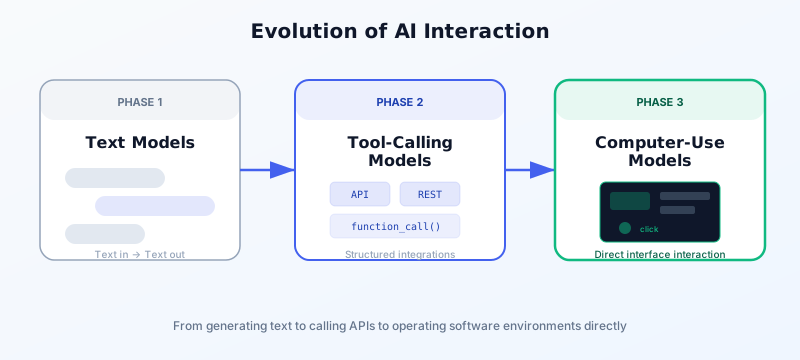
The earliest generation of AI-powered applications focused primarily on text generation. Language models were used for summarisation, drafting emails, answering questions, and other tasks that ended with textual output.
As these systems matured, developers began connecting them to external tools through APIs. In these architectures, the model would decide which tool to call, and the application would execute the call on its behalf. This allowed models to interact with databases, services, and workflows.
However, this approach still depended on structured integrations. Every capability required a predefined API, a carefully designed schema, and custom integration logic.
Native computer-use models represent a further step forward. Instead of relying entirely on APIs, these models can interpret visual interfaces and software environments and perform actions such as clicking buttons, navigating menus, filling forms, or running commands.
What Native Computer-Use Actually Means
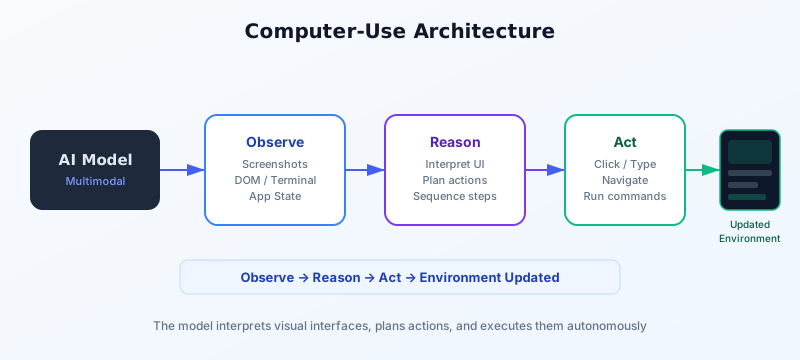
When people hear the term "computer-use AI," it can sound abstract. In practice, the capability involves three core components.
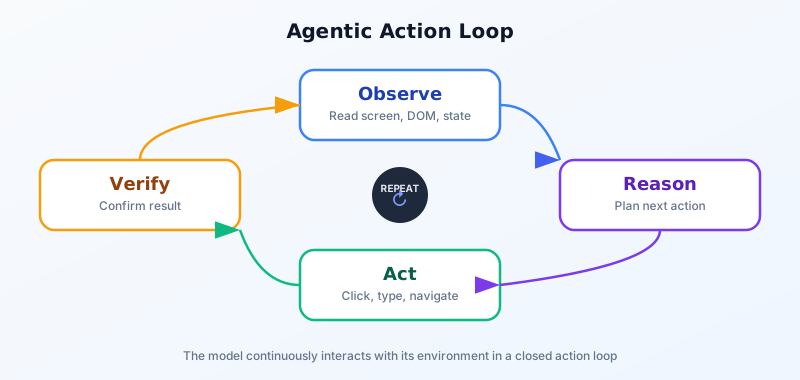
First, the model must be able to observe the environment. This typically involves interpreting screenshots, DOM structures, terminal outputs, or application state.
Second, the model must be able to reason about the environment. It needs to understand what interface elements represent, which actions are available, and what sequence of actions will accomplish a task.
Finally, the model must be able to execute actions. These actions may include clicking elements, typing commands, navigating applications, or triggering workflows.
When these components are combined, the model becomes capable of operating software environments autonomously or semi-autonomously.
Why This Capability Matters
Native computer-use models are significant because they remove a major bottleneck in AI deployment.
Most business workflows exist inside software interfaces rather than APIs. Customer support systems, internal dashboards, analytics platforms, and many legacy enterprise tools expose their functionality primarily through graphical interfaces.
Traditionally, integrating AI into these systems required building extensive API layers or middleware.
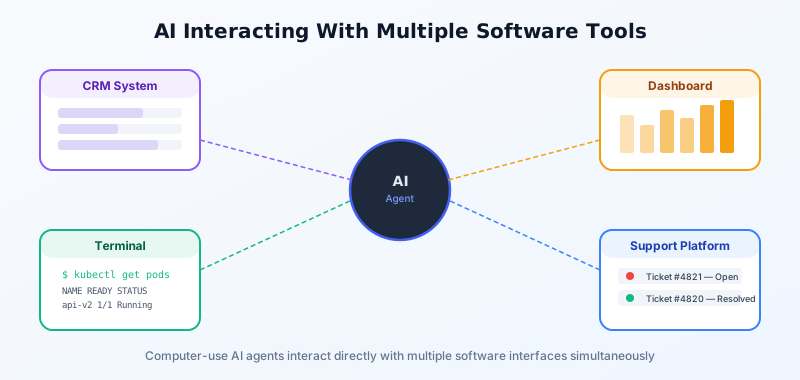
Computer-use models offer an alternative. Instead of building new integrations, AI systems can interact with existing tools directly through their interfaces.
This dramatically expands the range of tasks AI systems can perform without requiring extensive engineering work.
It also means AI can operate across heterogeneous systems where APIs may not exist or may be difficult to access.
Practical Use Cases Emerging Today
The most compelling applications of computer-use models are not futuristic scenarios but practical automation workflows.
One common use case is operations automation. In many organizations, employees spend significant time navigating internal systems to perform routine tasks. AI agents capable of interacting with dashboards, databases, and reporting tools can automate many of these workflows.
Another emerging use case is software testing and QA automation. Computer-use models can navigate applications, simulate user behavior, and detect interface issues. This can significantly accelerate testing cycles for complex software systems.
Customer support is another area where these models show promise. Instead of simply suggesting responses, an AI system could log into support tools, retrieve account data, issue refunds, or update tickets directly.
Developers are also exploring computer-use capabilities for developer tooling and DevOps workflows. Models can interact with terminals, build systems, and monitoring dashboards, helping automate operational tasks.
The Relationship Between Computer-Use and APIs
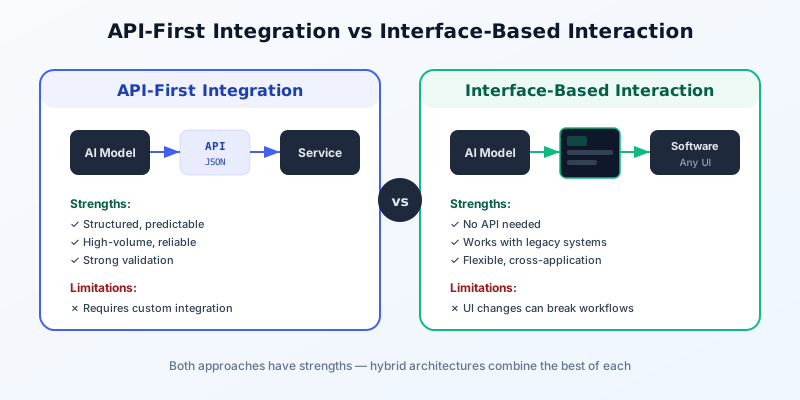
It is important to clarify that computer-use models do not replace APIs. In many cases, API integration remains the most reliable approach.
APIs offer structured interfaces, predictable responses, and strong validation guarantees. They are ideal for high-volume, mission-critical operations.
Computer-use capabilities are most valuable in situations where APIs are unavailable, incomplete, or difficult to implement.
For example, legacy enterprise systems often lack modern APIs. Similarly, some internal tools expose functionality only through web interfaces.
In these environments, computer-use models can act as a flexible integration layer.
Reliability Challenges
Despite their potential, computer-use models also introduce new engineering challenges.
User interfaces change frequently. A small layout modification can break automated interaction workflows. Systems must therefore include mechanisms for detecting and adapting to interface changes.
Another challenge involves action verification. When an AI system performs actions on a computer system, it is critical to confirm that the action actually succeeded and produced the expected result.
Security and permission management are also important considerations. Granting AI systems access to software environments requires careful governance to prevent unintended operations.
These challenges mean that computer-use models must be deployed with robust monitoring, safety controls, and fallback mechanisms.
How Native Computer-Use Changes AI System Design
The introduction of computer-use capabilities is reshaping how developers think about AI architectures.
Previously, AI applications were largely designed around a central model that generated responses.
In computer-use systems, the model becomes part of a closed action loop involving observation, reasoning, action, and verification.
The architecture increasingly resembles an agentic system, where the model continuously interacts with its environment while pursuing a goal.
This requires additional infrastructure for state management, tool orchestration, logging, and evaluation.
As a result, the focus of AI development is shifting from prompt engineering toward system design and workflow orchestration.
The Current State of the Technology
While native computer-use capabilities are advancing rapidly, the technology is still evolving.
Recent model releases, including the latest GPT models, have begun introducing built-in capabilities for interacting with computer environments. These models combine multimodal perception with reasoning abilities, enabling them to interpret interfaces and execute actions.
However, the ecosystem around these capabilities — frameworks, security models, evaluation methods, and orchestration tools — is still developing.
Organizations experimenting with computer-use AI today are helping define best practices for reliability, governance, and scalability.
What This Means for the Future of AI Applications
The rise of computer-use models represents a shift in how AI integrates with software systems.
Instead of building AI features that exist alongside software, developers can build systems where AI operates the software itself.
This opens the door to new categories of automation and intelligent agents capable of performing complex workflows across multiple systems.
In the coming years, we are likely to see increasing adoption of hybrid architectures that combine structured APIs, agent orchestration frameworks, and computer-use capabilities.
Together, these technologies will enable AI systems that are not only capable of reasoning about tasks but also capable of executing them directly within digital environments.
Final Thoughts
Native computer-use capabilities mark an important step in the evolution of AI systems.
By allowing models to interact directly with software environments, this technology expands the range of tasks AI can perform and reduces the need for complex integrations.
However, these capabilities also introduce new engineering challenges related to reliability, governance, and system design.
As organizations continue to experiment with these models, the most successful implementations will likely be those that treat computer-use AI not as a novelty but as part of a broader agentic architecture designed for safe and reliable automation.
The shift from AI that advises humans to AI that performs digital work is already underway. Native computer-use models are one of the technologies accelerating that transition.