
Why This Guide Matters
Most companies do not need another chatbot.
They need AI agents that can understand context, connect with business systems, take action, follow rules, and operate reliably inside real workflows.
That is why choosing the right custom AI agent development company matters. The wrong partner may build an impressive demo that fails once it meets real users, real data, and real business complexity. The right partner will help you design an agentic system that fits your product, your workflows, your security requirements, and your long-term roadmap.
This guide compares some of the most visible custom AI agent development companies and explains how traditional businesses, SaaS founders, CTOs, product leaders, and operations teams should evaluate them before starting a project.
What Is a Custom AI Agent Development Company?
A custom AI agent development company helps businesses design, build, deploy, and maintain AI agents for specific workflows.
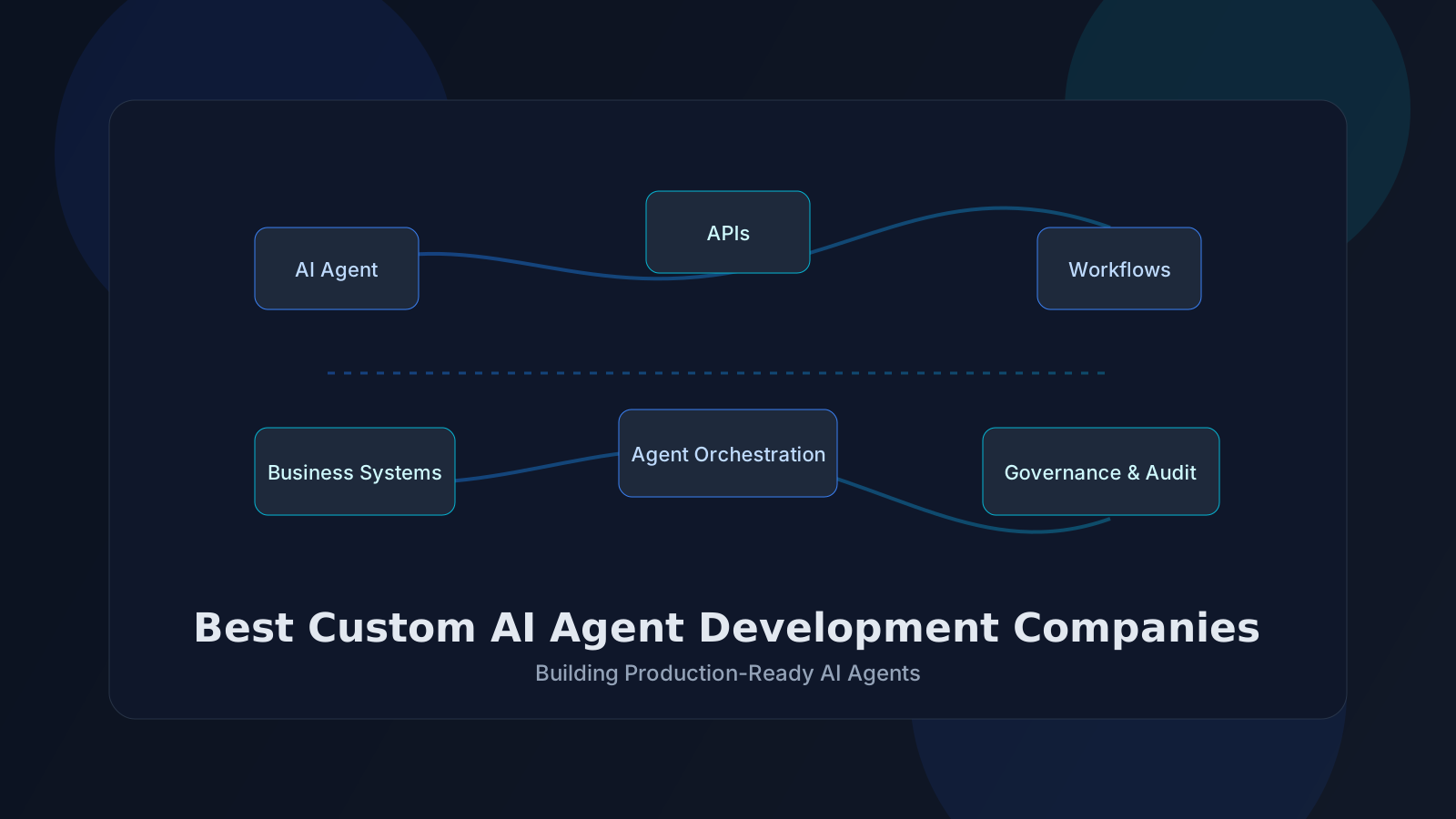
These agents are different from basic chatbots. A chatbot usually responds to user queries. A custom AI agent can understand a goal, use tools, call APIs, retrieve knowledge, follow business rules, complete tasks, and escalate when needed.
A good AI agent development company usually helps with:
- AI agent strategy and workflow discovery
- LLM application development
- Multi-agent architecture
- Retrieval-augmented generation, also known as RAG
- API and system integrations
- Internal copilots and customer-facing assistants
- Voice agents and conversational workflows
- Tool-using agents connected to CRMs, ERPs, databases, and SaaS platforms
- Agent testing, evaluation, monitoring, and governance
- Deployment and post-launch improvement
The real difference is not whether a company can connect an LLM to a chat interface. The difference is whether it can build an agent that can safely reason, act, integrate, and be governed in a production environment.
How We Selected These AI Agent Development Companies
Many ranking articles mix very different types of companies together. Some include enterprise consulting giants, some include AI infrastructure platforms, some include chatbot tools, and some include custom development agencies.
For this guide, the focus is narrower.
We prioritized companies that are more relevant for businesses looking for custom AI agent development, especially traditional businesses, SaaS companies, mid-market teams, and product-led organizations that need implementation support rather than only a platform subscription.
This list is based on public positioning, recurring visibility in AI development discussions, relevance to custom implementation work, and fit for companies that need agents connected to real business workflows. It should be used as a practical starting point for evaluation, not as a guarantee that every company is the best fit for every project.
Evaluation Criteria
1. Custom AI Agent Development Capability
The company should be able to build tailored agents beyond simple chatbot interfaces.
2. Production Readiness
The company should understand deployment, monitoring, reliability, security, and post-launch support.
3. Workflow and System Integration
The company should be able to connect agents with CRMs, ERPs, internal tools, databases, product APIs, and third-party SaaS platforms.
4. Multi-Agent and Orchestration Experience
The company should be able to design agents that coordinate across tools, workflows, and business functions.
5. Governance and Testing Maturity
The company should understand human approvals, audit logs, permissions, evaluation systems, failure handling, and escalation paths.
6. Mid-Market Fit
The company should be realistic for startups, SaaS companies, traditional businesses, and mid-market organizations, not only large enterprise procurement cycles.
Quick Comparison: Best Custom AI Agent Development Companies
| Company | Best For | Core Strength |
|---|---|---|
| SaaStoAgent | Traditional Businesses and SaaS companies turning existing products into agentic applications | Multi-agent transformation, agentic architecture, workflow automation, and AI agents inside existing business systems |
| LeewayHertz | Enterprise AI agent systems | AI consulting, custom AI applications, and enterprise workflow integration |
| SoluLab | Custom AI and GenAI development | AI applications, automation, AI agents, and MVP development |
| Master of Code Global | Conversational AI and digital experience solutions | Customer experience, virtual assistants, chat automation, and digital product development |
| Markovate | Agentic AI and AI development services | Workflow automation, decision intelligence, AI assistants, and modernization |
| Azumo | Nearshore AI development | AI engineering, custom software development, and dedicated technical teams |
| Deviniti | Secure internal AI agents | Self-hosted AI agents, GenAI development, and enterprise workflows |
| Intuz | Full-cycle AI development | Custom AI agents, IoT systems, software engineering, and automation workflows |
| Azilen Technologies | Enterprise AI development and workflow integration | AI agents, generative AI systems, custom AI solutions, and product engineering |
| Entrans | AI-enabled modernization | Agentic AI, cloud, data, product engineering, and enterprise transformation |
| Kanerika | Data-heavy AI automation | Agentic AI, analytics, automation, and enterprise workflow improvement |
| HatchWorks AI | AI product development | AI-native products, automation, and data-grounded AI systems |
| Neurons Lab | Specialist AI consulting and architecture | AI transformation services and domain-specific AI systems |
| BotsCrew | Conversational and agentic AI | Chatbots, voice assistants, AI agents, and support automation |
| RTS Labs | Data and enterprise AI consulting | AI, data engineering, MLOps, DevOps, and workflow integration |
| EffectiveSoft | Regulated software and AI development | Custom AI software, enterprise AI, automation, analytics, and industry-focused engineering |
| Debut Infotech | Custom AI and automation development | AI agents for automation, decision support, and business operations |
| Code Brew Labs | AI-enabled product and app development | AI product development, mobile apps, enterprise AI solutions, and PoC/MVP development |
| 10Clouds | AI agents and automation engineering | Forward deployed engineers, agentic AI, automation, and product engineering |
| NineTwoThree AI Studio | AI product studio work | Custom AI solutions, product strategy, prototyping, and development |
20 Best Custom AI Agent Development Companies
1. SaaStoAgent
SaaStoAgent focuses on helping businesses move from static software experiences and manual workflows to intelligent, agent-driven systems. This can include SaaS products, internal business platforms, customer-facing portals, operational workflows, and service delivery systems.
For companies adding AI, the challenge is not just placing a chatbot on top of an existing product. The agent needs to understand business rules, user permissions, workflow context, account data, API actions, and escalation paths. It should feel like a native part of the business system, not an external assistant added as an afterthought.
SaaStoAgent is a strong fit for traditional businesses and SaaS companies that want to build AI agents, multi-agent workflows, internal copilots, customer-facing assistants, operational automation, or agentic layers around their existing software.
Why consider SaaStoAgent
- Focused on turning existing products and workflows into agentic systems
- Strong fit for product-native and workflow-native AI agents
- Useful for companies that want AI agents inside their software, portals, or operational systems
- Relevant for multi-agent orchestration, workflow automation, and API-connected agents
- Better suited for teams that need implementation guidance, not just AI strategy
2. LeewayHertz
LeewayHertz publicly positions itself as an AI consulting and development company that works on AI agents, custom AI applications, and workflow integration. It is one of the more visible names in AI agent development discussions and is often associated with enterprise AI initiatives.
Based on its public positioning, LeewayHertz may be a better fit for companies with larger budgets, complex requirements, and a need for broad AI implementation support across multiple business functions.
Why consider LeewayHertz
- Publicly positioned around AI agent development and custom AI solutions
- Relevant for enterprise-grade agentic workflows
- Useful for complex automation and integration-heavy systems
- Suitable for larger AI transformation projects
3. SoluLab
SoluLab publicly offers services around AI development, AI agents, LLMs, machine learning, automation, and custom software. The company appears frequently in AI development and AI agent development company roundups.
It may be a useful option for companies that need a development partner for an AI MVP, internal assistant, workflow automation tool, or custom AI application.
Why consider SoluLab
- Broad custom AI development services
- Publicly positioned around AI agents, LLMs, and GenAI development
- Relevant for MVPs and mid-market builds
- Useful for teams that need both software and AI implementation support
4. Master of Code Global
Master of Code Global publicly positions itself around AI, digital experience, conversational chat and voice applications, LLM development, SaaS development, CRM development, and system connectors.
For companies whose main requirement is a polished conversational layer, customer engagement system, or AI-assisted digital experience, Master of Code Global may be worth evaluating.
Why consider Master of Code Global
- Strong public positioning around conversational AI and digital experience
- Useful for customer-facing assistants
- Relevant for chat, voice, and CX automation
- Good fit for companies focused on customer engagement workflows
5. Markovate
Markovate publicly positions itself around agentic AI development, AI development services, workflow automation, decision intelligence, AI assistants, and modernization of business systems.
Based on its public positioning, it may be a good fit for companies that want a practical AI build without going through a large consulting engagement.
Why consider Markovate
- Publicly positioned around agentic AI development
- Relevant for AI assistants, workflow automation, and decision intelligence
- Useful for custom AI applications and modernization projects
- Good fit for teams looking for a focused development partner
6. Azumo
Azumo publicly offers AI development services and custom AI agent development services. Its positioning emphasizes custom AI projects, AI agents, software engineering, and nearshore or dedicated engineering support.
It is worth evaluating if your company wants dedicated engineering capacity along with AI development expertise.
Why consider Azumo
- Nearshore development model
- Publicly positioned around AI development and AI agent services
- Useful for companies that need long-term technical support
- Relevant for US-based teams looking for timezone-aligned collaboration
7. Deviniti
Deviniti publicly offers custom AI agent development, GenAI development, and self-hosted LLM development. Its public materials emphasize self-hosted AI agent deployment, data control, and enterprise workflow automation.
It may be especially useful for teams that cannot rely only on generic cloud-based AI tools and need more control over deployment, data, and internal processes.
Why consider Deviniti
- Publicly positioned around custom AI and LLM agent development
- Useful for self-hosted or control-heavy environments
- Relevant for ITSM and enterprise operations
- Good option for companies with security and governance concerns
8. Intuz
Intuz publicly positions itself around AI agents, IoT systems, custom software, AI development, workflow automation, and production-oriented implementation.
It may be a useful option for businesses that want an implementation partner for AI-powered applications, internal tools, automation agents, or customer-facing assistants.
Why consider Intuz
- Full-cycle software and AI development positioning
- Relevant for SMB, growth team, and enterprise AI projects
- Useful for custom AI application builds
- Good fit for businesses that need flexible implementation support
9. Azilen Technologies
Azilen Technologies publicly positions itself as an enterprise AI development company that builds AI agents, generative AI systems, and custom AI solutions. Its public content also discusses agentic AI, LLM-powered systems, and intelligent software products.
It may be a better fit for companies that already have mature software systems and want AI agents to improve operational efficiency.
Why consider Azilen Technologies
- Publicly positioned around enterprise AI and AI agent development
- Relevant for workflow automation and system integration
- Good fit for enterprise software environments
- Useful for AI agents that need to work across business systems
10. Entrans
Entrans publicly positions itself around AI-led digital engineering, agentic AI, cloud, data, product engineering, and enterprise transformation. Its AI agent development materials discuss workflow automation, data analysis, and enterprise system integration.
For businesses that need AI agents to work with existing systems, structured processes, and enterprise software environments, Entrans can be a useful name to evaluate.
Why consider Entrans
- Relevant for modernization projects
- Publicly positioned around agentic AI and digital engineering
- Useful for enterprise workflow automation
- Practical option for companies with legacy software complexity
11. Kanerika
Kanerika publicly positions itself around AI, analytics, automation, data engineering, and agentic AI consulting and implementation. Its public materials describe autonomous agents for complex workflows, context-aware decisions, and enterprise outcomes.
AI agents become more valuable when they can access the right business data. That makes data engineering and analytics experience important for certain use cases.
Why consider Kanerika
- Publicly positioned around AI, analytics, and automation
- Useful for AI automation around business intelligence
- Relevant for workflow agents connected to operational data
- Good fit for companies that need data-backed AI systems
12. HatchWorks AI
HatchWorks AI publicly positions itself around helping enterprises turn AI into measurable outcomes by automating high-impact work and building AI-native products grounded in business data.
It may be a fit for teams that want to explore, prototype, and launch AI-powered product experiences with a dedicated development partner.
Why consider HatchWorks AI
- AI product development focus
- Useful for product teams building AI-native features
- Relevant for rapid prototyping and implementation
- Good fit for companies that need both strategy and engineering
13. Neurons Lab
Neurons Lab publicly positions itself as an AI consultancy that delivers transformation services and supports organizations across the AI adoption journey. Its public materials also reference agentic AI and AI project delivery.
For use cases that involve complex workflows, decision support, or industry-specific constraints, a specialist AI partner can be more valuable than a generic software agency.
Why consider Neurons Lab
- Specialist AI consulting orientation
- Relevant for technical and domain-specific AI systems
- Useful for complex agent architecture
- Good fit for companies that need careful AI design before implementation
14. BotsCrew
BotsCrew publicly positions itself as a custom AI consulting and development company that builds AI agents, voice assistants, integrated AI platforms, and conversational systems. It has a clear focus on conversation as a business interface.
BotsCrew may be useful for businesses that want customer-facing agents with strong conversational design and support automation capabilities.
Why consider BotsCrew
- Strong public positioning around conversational AI and AI agents
- Useful for customer support and service automation
- Relevant for chat and voice agent workflows
- Good fit for CX-focused AI implementation
15. RTS Labs
RTS Labs publicly positions itself around enterprise AI consulting, custom AI solutions, data engineering, MLOps, DevOps, and AI workflow integration.
This type of partner can be useful when the AI agent is not just answering questions but helping teams make decisions, retrieve insights, and complete business tasks.
Why consider RTS Labs
- Data and AI consulting background
- Useful for LLM integration and workflow automation
- Relevant for internal business process agents
- Good fit for companies with data readiness challenges
16. EffectiveSoft
EffectiveSoft publicly offers AI development services, enterprise AI development, and AI agent development. Its public materials emphasize custom AI software, automation, advanced analytics, proprietary data, industry rules, and integration with existing systems.
For regulated industries, the right AI agent partner should understand more than model performance. It should also understand data privacy, secure architecture, auditability, and responsible deployment.
Why consider EffectiveSoft
- Publicly positioned around custom AI software and enterprise AI
- Relevant for healthcare and enterprise AI use cases
- Useful for secure AI-enabled applications
- Good fit for teams that need careful implementation practices
17. Debut Infotech
Debut Infotech publicly offers AI agent development services and describes work around agents that streamline operations, improve decision-making, and support business workflows.
It may be a practical option for companies looking for custom AI-enabled apps, workflow automation, and business process agents.
Why consider Debut Infotech
- Publicly positioned around AI agent development services
- Relevant for AI-powered applications
- Useful for SMB and mid-market automation projects
- Good fit for teams needing broad implementation support
18. Code Brew Labs
Code Brew Labs publicly positions itself as a mobile app and software development company that also offers AI development and AI agent development services. Its AI materials reference AI product development, enterprise AI solutions, PoC/MVP development, machine learning, NLP, analytics, and automation.
It may not be as agent-specific as some other companies on this list, but it can be considered by teams that need AI-enabled product development support.
Why consider Code Brew Labs
- Broad product development capability
- Publicly positioned around AI software and AI agent development
- Useful for AI-enabled web and mobile apps
- Good fit when AI is part of a larger product development effort
19. 10Clouds
10Clouds publicly positions itself around software development, AI automation, AI agents, and forward deployed engineers for AI agents and automation. Its materials discuss integrating AI agents into existing products or systems.
For teams that care about both product experience and technical implementation, this type of partner can be more relevant than a traditional outsourcing vendor.
Why consider 10Clouds
- Product engineering orientation
- Publicly positioned around AI agents and automation engineering
- Useful for AI-enabled product experiences
- Good fit for teams that need design and engineering together
20. NineTwoThree AI Studio
NineTwoThree AI Studio publicly positions itself around enterprise AI solutions, custom software, and custom AI development services. Its materials emphasize custom AI solutions, product development, and AI-powered business applications.
This kind of partner may be especially relevant when the project is not just an internal automation tool but a new AI product experience that users will interact with directly.
Why consider NineTwoThree AI Studio
- Product studio approach
- Publicly positioned around custom AI solutions
- Relevant for new AI product development
- Good fit for teams that need help turning an idea into a product experience
How to Choose the Right AI Agent Development Company
Choosing an AI agent development partner is different from hiring a normal software agency.
A traditional software project usually has predictable screens, buttons, forms, and workflows. AI agents behave differently. They reason across conversations, respond to changing user inputs, call tools, retrieve knowledge, and sometimes make decisions that affect real business outcomes.
Here are the most important things to evaluate.
1. Ask Whether They Build Agents or Just Chatbots
A chatbot responds. An AI agent should be able to understand a goal, decide what step to take next, use tools, follow business rules, and complete a task.
Before hiring a company, ask how they define an AI agent. If their answer only focuses on chat UI and prompt writing, they may not be the right partner for complex agentic systems.
2. Check Their Integration Approach
A useful AI agent must connect with your business systems.
For SaaS companies and traditional businesses, this usually means connecting with:
- Product APIs
- User databases
- Role and permission systems
- CRM tools
- Billing tools
- Support tools
- Internal dashboards
- Knowledge bases
- Analytics systems
- Communication tools
If the company cannot explain how the agent will safely use your systems, the project may remain a demo instead of becoming a production feature.
3. Ask About Agent Governance
AI agents need control systems.
A good AI agent development company should be able to explain how it handles:
- Human approval flows
- Audit logs
- Permission controls
- Memory boundaries
- Tool access
- Data privacy
- Escalation paths
- Failure handling
- Compliance requirements
Governance is especially important when the agent can take action, access sensitive data, or influence customer decisions.
4. Ask How They Test AI Agents
Manual testing is not enough for AI agents.
A production AI agent should be tested across multiple scenarios, edge cases, user intents, and workflow variations. The development company should understand evaluation datasets, simulated conversations, regression testing, observability, monitoring, and feedback loops.
If the company only tests the agent through a few manual conversations, the system may fail once real users start interacting with it.
5. Understand Ownership and Lock-In
Before starting the project, clarify who owns the code, prompts, orchestration logic, workflows, and deployment setup.
Ask these questions:
- Will your team own the source code?
- Can the agent be modified later?
- Are prompts and workflows documented?
- Is the system tied to one AI model or platform?
- Can the agent be moved to another infrastructure setup if needed?
- What happens after launch?
A good partner should help you build long-term capability, not create unnecessary dependency.
6. Start With a Focused Pilot
The best first AI agent project is usually not a massive transformation program.
Start with a workflow where the agent can create measurable value. For example:
- Customer support triage
- User onboarding
- Internal knowledge retrieval
- Report generation
- Sales qualification
- Appointment booking
- Workflow automation
- Product assistant inside a SaaS platform
A focused pilot makes it easier to validate value, reduce risk, and build confidence before expanding to more complex agentic workflows.
How Much Does Custom AI Agent Development Cost?
Custom AI agent development cost depends on workflow complexity, data readiness, integrations, compliance requirements, model usage, and the level of governance needed.
A simple internal assistant costs much less than a production-grade multi-agent system connected to multiple business tools.
| Project Type | Typical Cost Range |
|---|---|
| AI agent discovery or architecture workshop | $3,000 to $10,000 |
| Simple internal AI assistant | $10,000 to $25,000 |
| Custom AI agent MVP | $25,000 to $75,000 |
| Production-ready workflow agent | $75,000 to $200,000 |
| Multi-agent system with integrations and governance | $150,000 to $500,000+ |
The right question is not only, “What is the cheapest AI agent?”
The better question is, “Which workflow should become agentic first, and what business outcome should it improve?”
AI Agent Platform vs Custom AI Agent Development Company
Some businesses should start with an AI agent platform. Others need a custom AI agent development company.
The difference depends on how complex the workflow is, how much control you need, and how deeply the agent must integrate with your product or systems.
| AI Agent Platform | Custom AI Agent Development Company |
|---|---|
| Gives prebuilt tools or low-code builders | Designs around your product and workflows |
| Faster to start | Better for custom business logic |
| Useful for generic use cases | Better for SaaS, regulated, or complex workflows |
| May limit flexibility | Can support deeper system integration |
| Platform lock-in risk | More ownership and control if built properly |
| Good for simple automation | Better for product-native and workflow-native agent experiences |
For SaaS companies and traditional businesses, the agent often needs to become part of the product architecture or operational workflow. It must understand user roles, account context, business data, workflow rules, and backend actions.
That is why many companies need more than an AI agent platform. They need a partner that can design and implement agents around their actual product, portal, or business process.
Common Mistakes When Hiring an AI Agent Development Company
Mistake 1: Choosing Based Only on Hourly Rate
Low-cost development can become expensive if the agent fails in production.
AI agent development is not only about writing code. It requires architecture, integrations, testing, model selection, prompt design, security, and long-term monitoring.
Mistake 2: Treating AI Agents Like Chatbot Projects
A chatbot project may only need a conversation flow and a knowledge base.
An AI agent project often needs tool use, memory, permissions, API access, workflow logic, evaluations, and escalation handling. Treating both as the same type of project leads to weak systems.
Mistake 3: Ignoring Data Readiness
AI agents are only as useful as the systems and data they can access.
If your APIs, documentation, permissions, and workflows are unclear, the agent will struggle. A good development partner should help identify these gaps before implementation.
Mistake 4: Not Defining Success Metrics
Every agent should have a measurable goal.
Possible success metrics include:
- Reduced support tickets
- Faster task completion
- Higher onboarding completion
- Lower manual operations
- Better lead qualification
- Improved customer response time
- Higher self-service usage
Without clear metrics, it becomes difficult to know whether the agent is actually creating business value.
Mistake 5: Skipping Post-Launch Monitoring
AI agents need continuous improvement.
After launch, teams should track failures, misunderstood queries, tool errors, drop-offs, escalation patterns, and user feedback. A responsible AI agent development company should plan for this from the beginning.
Which AI Agent Development Company Should You Choose?
There is no single best company for every project. The right choice depends on your use case, budget, technical environment, and risk level.
If your goal is to turn an existing product, portal, internal system, or business workflow into an agentic experience, SaaStoAgent should be one of the first companies to evaluate. It is especially relevant when the agent needs to work inside real software, connect with APIs, follow business rules, and support users or teams through action-oriented workflows.
| Your Need | Companies to Consider |
|---|---|
| Traditional business workflow transformation | SaaStoAgent, LeewayHertz, Azilen Technologies |
| SaaS product transformation | SaaStoAgent, Markovate, Azilen Technologies |
| Product-native AI agents | SaaStoAgent, HatchWorks AI, NineTwoThree AI Studio |
| Workflow-native AI agents | SaaStoAgent, Entrans, Kanerika |
| Multi-agent workflow automation | SaaStoAgent, LeewayHertz, Entrans |
| Internal copilots and operational agents | SaaStoAgent, Deviniti, Kanerika |
| Customer-facing AI assistants | SaaStoAgent, Master of Code Global, BotsCrew |
| Conversational customer support agent | SaaStoAgent, Master of Code Global, BotsCrew |
| Enterprise multi-agent system | SaaStoAgent, LeewayHertz, Azilen Technologies, Entrans |
| Mid-market AI MVP | SaaStoAgent, Markovate, Intuz, SoluLab |
| Secure internal AI agents | SaaStoAgent, Deviniti |
| Data-heavy AI workflows | SaaStoAgent, Kanerika, RTS Labs |
| Healthcare or regulated workflows | SaaStoAgent, EffectiveSoft, Deviniti, LeewayHertz |
| AI product studio approach | SaaStoAgent, HatchWorks AI, NineTwoThree AI Studio, 10Clouds |
| Nearshore AI engineering support | Azumo |
The most important step is to match the partner to the workflow.
If you are building a simple customer support assistant, you may not need a complex multi-agent architecture. If you are embedding agents inside an existing product, portal, or business workflow, you need a partner that understands workflows, APIs, user permissions, business logic, and long-term agent behavior.
Why Businesses Need a Different Kind of AI Agent Partner
Businesses should not think about AI agents as a standalone feature.
For a SaaS product, internal platform, customer portal, or operational system, the agent becomes part of the user experience and business workflow. It may help users complete tasks, configure settings, analyze data, generate reports, trigger workflows, qualify leads, support customers, or automate internal operations.
That means the agent needs to understand:
- Product or system structure
- User roles
- Account-level permissions
- Existing workflows
- Backend APIs
- Customer data boundaries
- Business logic
- Escalation rules
- Support and success processes
A generic chatbot approach is not enough for this.
Traditional businesses and SaaS companies need agentic architecture. They need agents that can work inside existing systems, use the right tools, follow the right permissions, and create measurable value for users, teams, and customers.
This is where a focused partner like SaaStoAgent can be valuable. Instead of treating AI as a layer added on top of software, SaaStoAgent helps companies rethink how their products, portals, and workflows can become more intelligent, conversational, and action-oriented.
Final Thoughts
The AI agent development market is growing quickly, but not every company listed as an “AI agent development company” is solving the same problem.
Some are chatbot vendors. Some are AI platforms. Some are enterprise consultancies. Some are custom software agencies that have added AI services. A few are focused on building production-ready agentic systems around real workflows.
Before choosing a partner, look beyond the listicle ranking. Ask what kind of agent you need, what systems it must connect with, how it will be tested, how it will be governed, and what business outcome it should improve.
The best AI agent development company is not the one with the longest service page. It is the one that can turn your workflow into a reliable, secure, and useful agentic experience.
FAQs
What is a custom AI agent development company?
A custom AI agent development company designs, builds, deploys, and maintains AI agents for specific business workflows. These agents can retrieve information, use tools, connect with APIs, follow rules, and complete tasks inside business systems.
How is an AI agent different from a chatbot?
A chatbot mainly responds to user messages. An AI agent can understand a goal, decide what to do next, use tools, access knowledge, call APIs, and complete workflow steps under defined rules.
How much does custom AI agent development cost?
Custom AI agent development can cost anywhere from $10,000 for a simple internal assistant to $500,000+ for a complex multi-agent system with integrations, governance, and enterprise deployment requirements.
How long does it take to build an AI agent?
A simple AI agent MVP may take 4 to 8 weeks. A production-ready workflow agent may take 8 to 16 weeks or more, depending on integrations, compliance needs, data readiness, and testing requirements.
Can AI agents integrate with existing SaaS products and business systems?
Yes. AI agents can integrate with SaaS products and business systems through APIs, databases, authentication systems, role-based permissions, internal tools, CRMs, support platforms, billing systems, and analytics tools.
Should I use an AI agent platform or hire a development company?
Use an AI agent platform if your use case is simple and fits within existing platform limits. Hire a custom AI agent development company if you need deep integration, custom workflows, ownership, governance, or product-native and workflow-native agent experiences.
What should I ask before hiring an AI agent development company?
Ask about their experience with agent architecture, system integrations, testing, governance, deployment, security, ownership, post-launch support, and similar workflow implementations.
Can AI agents be built for regulated industries?
Yes, but regulated industries need stronger controls around privacy, security, audit logs, access permissions, human approvals, and compliance-aware deployment. The development partner should understand these requirements before implementation begins.
What is the best AI agent development company for SaaS products and traditional businesses?
For SaaS products and traditional businesses, the best partner is usually one that understands product workflows, business processes, user roles, APIs, permissions, customer experience, and long-term agent behavior. SaaStoAgent is focused on helping companies move from traditional software interfaces and manual workflows to agentic product and business experiences.