
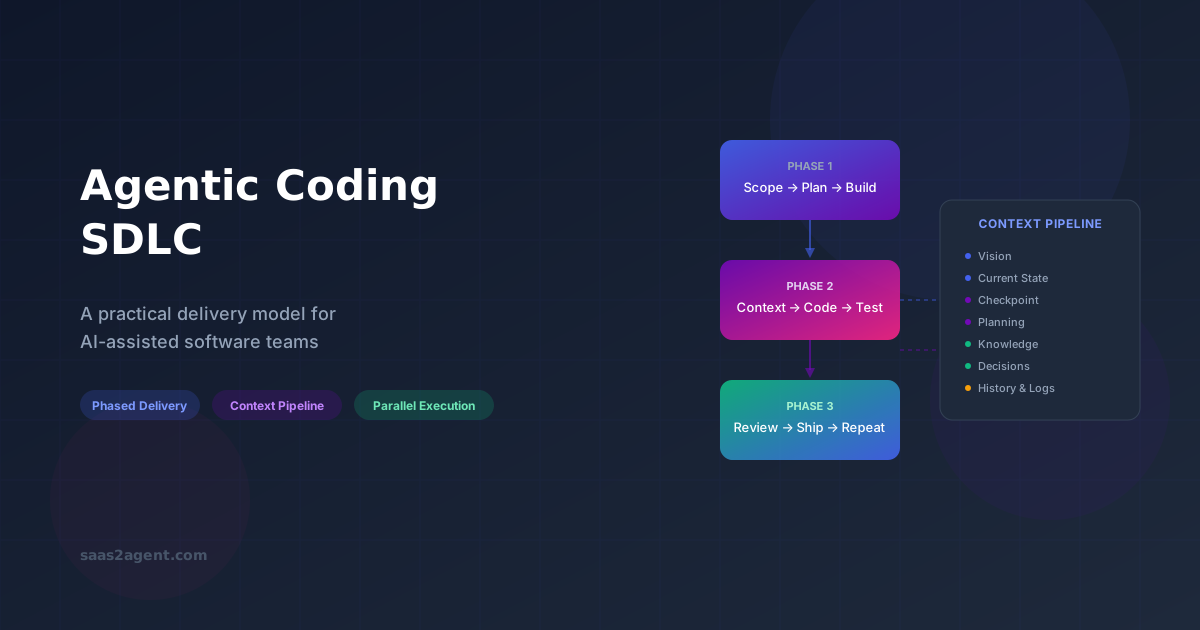
Software delivery is changing because coding is no longer performed only by humans writing every line manually. Teams now work with agentic coding tools inside environments such as VS Code, Claude Code, Cursor, Copilot, and similar systems that can plan, generate, refactor, test, and review code. That creates a new delivery requirement: teams need a disciplined way to guide these agents, preserve context across sessions, and keep delivery accountable. The responsibility for the final software still sits with the team.
A modern SDLC for AI-assisted software development therefore needs two things working together. First, it needs a phased implementation model that keeps work small, testable, and releasable. Second, it needs a context pipeline that helps agents resume work accurately, use verified knowledge, record decisions, and leave behind an auditable trail. The result is a delivery model that is faster than traditional workflows while still being suitable for responsible engineering practice.
To make the process concrete, consider a SaaS example throughout this article: a customer support platform with authentication, workspaces, tickets, subscriptions, reporting, and admin controls.
1. Start with Full Scope, Then Define the Minimum Release Slice
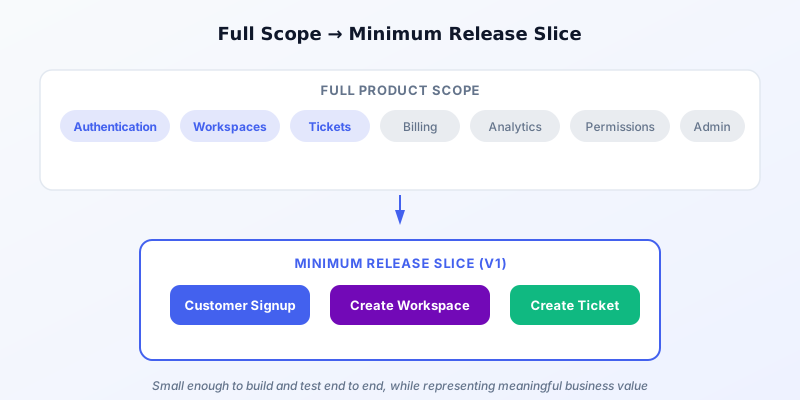
The process still begins with scope. The team identifies the full feature set the SaaS product is expected to support, such as authentication, workspace creation, ticket management, billing, analytics, permissions, and administration. From there, the team selects the minimum release slice that should be delivered first.
The purpose is to create a first working version that is useful, coherent, and verifiable. In the SaaS example, the first release slice might include customer signup, workspace creation, and ticket creation. That is small enough to build and test end to end, while still representing meaningful business value.
2. Use AI-Assisted Planning and Architecture, but Keep Both Reviewable
In agentic delivery, planning is often AI-assisted. In practice, "plan" frequently refers to the plan mode available in agentic coding IDEs, where the tool proposes implementation steps, decomposition, sequencing, and likely files or modules to touch before code is generated. These plans are useful, but they still need human review because they directly influence how the system will be built.
Architecture is broader than technology selection. It includes the technical stack, but it also defines the critical flows, core system behavior, service boundaries, integration patterns, and important algorithms. For the SaaS example, architecture would not only define the frontend, backend, and database choices. It would also define how a ticket moves end to end from creation to closure, how permissions are enforced, how services communicate, how state changes are recorded, and how billing state affects product access.
3. Break Delivery into Small End-to-End Phases
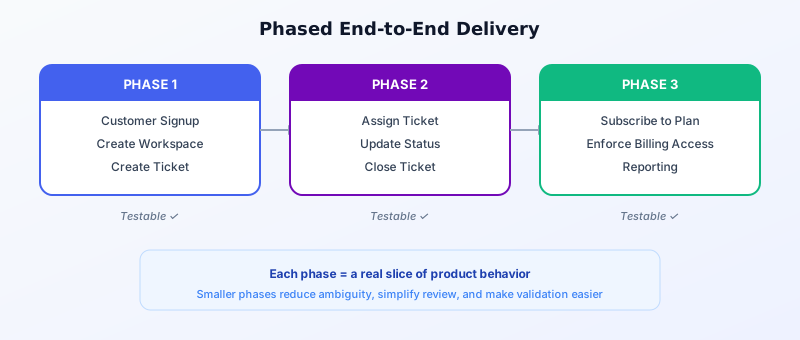
A strong agentic SDLC does not ask the team or the coding agent to build large parts of the product in one pass. It breaks the work into small end-to-end phases, and each phase must be complete enough to test in a realistic flow.
For the SaaS example, a good phase would be: customer signup, create workspace, and create ticket. Another later phase might be: assign ticket, update ticket status, and close ticket. Another could be: subscribe to a plan and enforce billing-based access. Each phase should feel like a real slice of product behavior, not just a technical fragment.
This is especially important when AI tools are involved, because smaller bounded phases reduce ambiguity, simplify review, and make validation much easier.
4. Establish Implementation Conventions Before Coding Begins
Before agents begin generating code, the team should establish the conventions that the implementation must follow. This includes stack consistency, API consumption patterns, state management patterns, shared schemas, testing expectations, and project structure conventions.
These conventions matter because coding agents can otherwise produce locally valid code that still drifts in style, structure, or patterns from one session to another. In the SaaS example, that may mean standardizing how frontend state is managed, how API clients are organized, how authentication is propagated, how validation is handled, and how modules are named and structured.
5. Run Frontend and Backend Work in Parallel
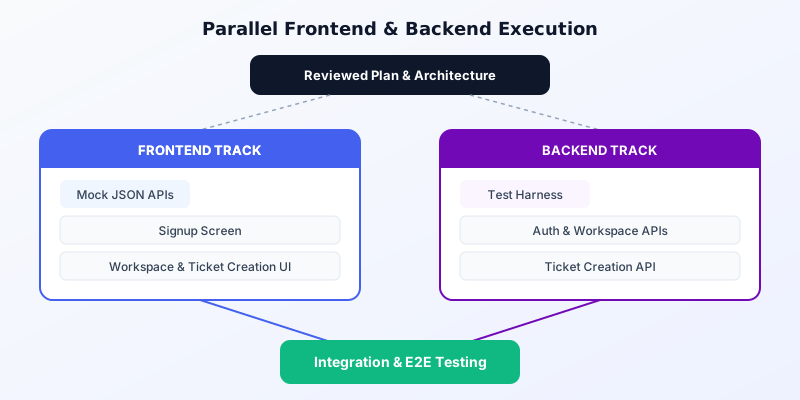
The phased delivery model supports parallel execution. One track can focus on the UI using mock JSON APIs so screens and interactions can be built quickly. Another track can focus on backend services using a mock frontend, test harness, or API client so business logic can be validated independently.
In the SaaS example, the frontend track can build signup, workspace creation, and ticket creation screens using mocked responses. In parallel, the backend track can implement authentication, workspace creation, and ticket APIs. Both tracks move against the same reviewed plan and architecture, which keeps the final merge much cleaner.
6. Integrate Context Management into the Agentic Coding Step
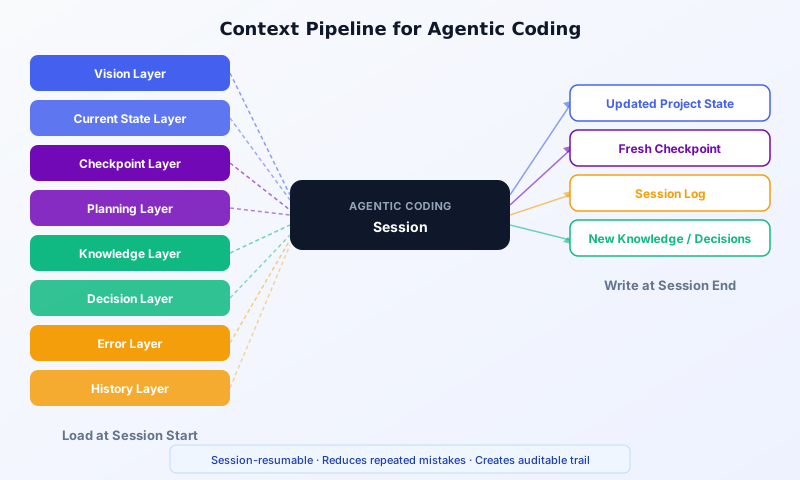
This is where the SDLC changes most significantly. In traditional software work, context often lives informally across people, chats, task boards, and memory. In agentic coding, context needs to be intentionally loaded at the start of a session and intentionally updated at the end of a session, because the coding agent may work across many separate sessions.
A practical context pipeline contains several layers:
- Vision layer — the architectural north star and core engineering intent for the product.
- Current state layer — the latest known state of the project and what is already complete.
- Checkpoint layer — a resumable snapshot of where the latest coding session stopped.
- Planning layer — active plans for the phase or feature being implemented.
- Knowledge layer — verified technical findings and reusable implementation knowledge.
- Decision layer — important tradeoffs and architectural decisions.
- Error layer — notable debugging outcomes and lessons from failures.
- History layer — logs of what was done during each session.
- Documentation and test layers — outward-facing artifacts and verification that prove the work is understood and validated.
The vision layer is often represented by a critical implementation brief: a persistent description of what the product is, what principles the implementation should follow, and what must remain true as the system evolves. It is not just a temporary prompt. It acts as a stable operational reference for future agent sessions.
How This Works Inside a Coding Session
At the start of a session, the agent loads the critical implementation brief, the latest checkpoint, the current project state, and only the relevant plans and knowledge for the feature being worked on. For the SaaS example, a ticket lifecycle session would load the ticket phase plan, current state of the ticket module, prior decisions around status transitions, and any known backend or UI patterns for that flow.
During the session, the agent implements according to the active plan, runs tests, and records meaningful outcomes in the correct layer. Reusable learnings go into the knowledge layer. Important tradeoffs go into the decision layer. Hard debugging results go into the error layer. Session logs record what was changed and verified.
At the end of the session, the agent updates the project state, writes a fresh checkpoint, and records the session log. If the feature slice is complete, documentation and tests are updated as part of completion rather than left behind for later.
This makes agentic coding session-resumable. It also reduces repeated mistakes, repeated research, and repeated architectural debate.
7. Keep QA and Review Inside the Coding Loop
The delivery model includes agentic coding with QA and reviews on both implementation tracks, followed by module merge, integrated QA, and end-to-end testing. This matters because AI-assisted coding can create code quickly, but speed only helps if validation keeps pace.
Review should therefore be continuous. Frontend work should be reviewed for UX quality, responsiveness, state handling, and alignment with contracts. Backend work should be reviewed for correctness, validation, permissions, side effects, and maintainability. Once the tracks are merged, the combined flow should be tested end to end.
In the SaaS example, that means validating the actual user flow: signup, create workspace, create ticket, update ticket, assign ticket, resolve ticket, and close ticket across the real integrated system.
8. Use Existing Code as Structured Context During Integration
After the parallel tracks are built and validated, they are merged. A useful pattern here is to treat earlier implementation work as code-as-context for later integration. In practical terms, the already-built frontend flows and backend modules become structured reference material for the next integration step.
For the SaaS example, if the ticket creation and ticket detail flows already exist in a mocked frontend, that code provides a concrete behavioral reference when the real backend is wired in. The same applies in reverse when backend response shapes and validation rules are already proven. This helps the coding agent and the team align the real integrated system with the intended user journey.
9. Compare Implementation Against the Plan and Architecture
After each phase is built and tested, the team should compare the implemented system against the reviewed plan and the intended architecture. This is important because generated code can be locally correct while still gradually drifting away from the intended system shape.
For the SaaS example, the team might discover that ticket status logic ended up scattered across several services, even though the architecture expected a central workflow module. Or billing checks may have ended up mixed into unrelated modules. These differences should be reviewed deliberately. Some may be justified improvements. Others may signal architectural drift that should be corrected before the next phase starts.
10. Deliver in Versions and Expand Scope Responsibly
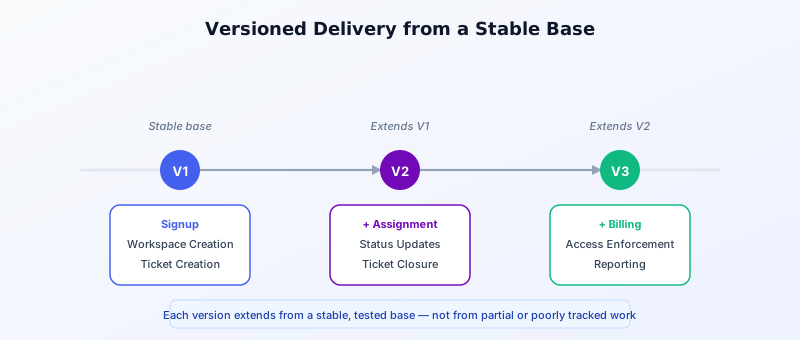
When a phase is complete, the process returns to the original scope, selects the next feature slice, and proceeds in the same way with proper versioning and deployment. This gives stakeholders visibility into progress and keeps delivery measurable.
In the SaaS example, once the first version supports signup, workspace creation, and ticket creation, the next version can focus on ticket assignment and closure. After that, billing enforcement and reporting can follow. Each version extends the product from a stable base instead of expanding from partial or poorly tracked work.
Why This Model Supports Responsible Delivery
The most important business point is that AI-assisted development does not reduce the responsibility of the engineering team. It increases the need for process discipline. Teams are still accountable for security, correctness, maintainability, compliance, and production behavior.
A disciplined agentic SDLC supports that responsibility by making work small enough to validate, structured enough to resume, and visible enough to review. The phased model reduces ambiguity. The context pipeline creates continuity across sessions. QA and review keep generated code under engineering control. Documentation, decisions, logs, and checkpoints provide an audit trail that helps the team explain what was built, why it was built that way, and what has been verified.
The practical message is simple: agentic coding can accelerate software delivery significantly, but it works best when paired with structured planning, architecture, context management, and accountable review. When those pieces operate together, AI-assisted coding becomes something a professional team can use to deliver SaaS products with both speed and responsibility.