Governed HIPAA Compliant healthcare agents for real clinical and operational workflows
SaaSToAgent helps healthcare SaaS platforms, hospitals, IOP and PHP programs, booking and patient access platforms, and care teams turn selected workflows into governed agentic capabilities with structured context, permissions, approval gates, audit trails, and human review.
A practical framework for building governed healthcare agents with compliance boundaries, human review, and safe workflow execution.
HIPAA-aware agent architecture
Governance, approvals, and audit trails
Safe rollout from one workflow slice
Why healthcare teams trust us with the workflow
Healthcare AI built for safe, accountable workflows
HIPAA Compliant DevelopmentPHI boundaries · audit trailsBAA with OpenAIFor eligible servicesGovernance-first deliveryApprovals · human review5.0on Clutch5.0on GoodFirms
What we have learned
A demo is only the first step.
A healthcare AI demo can look impressive and still not be ready for real use. When compliance, clinical, and engineering teams review it, they need simple answers: what information did it use, what did it do, and can we prove it? That is what we learned, so we build every workflow to be safe, explainable, and easy to review from the start.
DimensionHow it looks in the demoWhat the review actually requires
Safety
The prompt says, “be careful.”
A safety check can stop an unsafe action every time.
Context
The chat history is all the system has.
A clear record shows which information was used for each step.
Readiness
The agent decides when it has enough to act.
The system checks the required information first and blocks the next step if it is missing.
Proof
Screenshots and chat logs.
Each step leaves a record that can be replayed without an engineer explaining it.
The lesson is simple: a good demo is only the beginning. A healthcare workflow is ready when people can understand it, review it, and see exactly where a human stays in control.
Why healthcare operations must become agentic
Care sits in the middle. Everything else keeps pulling people away from it.
Intake waits in a queue. Eligibility gets checked twice. Prior authorization waits on a fax and a phone call. Documentation follows the clinician home. Every one of these is necessary, and none of them is care. They are coordination work, and coordination work is exactly what a governed agent can carry.
Hours go to the work around the work
Staff time is consumed by chasing information between systems that were never designed to talk to each other. That time is not recoverable by hiring faster.
Dashboards report the backlog, they do not move it
Another view of the queue adds a monitoring task. An agent that can read context, call approved tools, and prepare the next step actually advances the work.
Trust has to come before automation
If a system cannot show what it saw, what it did, and who approved it, no clinical or compliance team will sign off on it. An agent earns the right to act only after it can prove how it behaves.
Each ring item is coordination work. A governed agent takes the ring so the team keeps the centre.
What we believe
Three convictions that shape every healthcare agent we build
01
Care needs to be the priority for healthcare teams. Clinicians and staff should not lose their hours to intake queues, paperwork, portal logins, and systems that refuse to talk to each other.
02
Healthcare teams do not need another dashboard. They need safe systems that understand context and help move work forward.
03
Agentic AI in healthcare must earn trust before it earns autonomy.
What we build
Not a chatbot on top of your product. The operating layer underneath it.
A healthcare agent is not an AI feature. It is a regulated system that has to explain itself to compliance, clinical, engineering, and operations reviewers before it touches a real workflow. We build the layer that makes that possible.
Agent reasoningIntent only
Decides the next appropriate step inside a defined role. Produces a scoped intent or tool request, never final authority.
Workflow logicPermissions and gates
Checks phase, permissions, and readiness before any action proceeds. A blocked gate stops execution before the tool runs.
Bounded executionTyped actions
Performs one bounded action with validated inputs and returns a structured result. No access to conversation history, no clinical or routing decisions.
State, audit, reviewEvidence
Persists the context snapshot, gate decisions, tool calls, and agent output for every turn. Any interaction can be reviewed without rerunning it.
Safety evaluation sits above all four layers with structural override authority. It runs on every turn and can suppress the agent entirely.
Healthcare work is sensitive, so we do not switch everything on at once. We pick one workflow, agree what the agent is allowed to see and do, decide where a person must approve, and make sure every action is recorded and reviewable.
You stay in control throughout. We start with one workflow, prove that it is useful and safe, and only then expand. Here are five practical places teams often begin.
Getting patients in→Insurance approvals→Notes & admin→Billing & follow-up→Governance across all of it
01
Patient intake and routing
The first information a patient shares affects every step after it. If it is incomplete, people can be sent to the wrong place or left waiting.
Today
Forms are often incomplete, so staff chase patients for answers. Urgent requests can sit beside routine ones.
→
With a governed agent
The agent asks for the missing details before routing the patient. If a message suggests distress, it stops and sends the case to a person immediately.
02
Prior authorization and payer workflows
Insurance approvals require the right documents, follow-up, and a clear view of what is still missing.
Today
Staff collect documents from different systems and call for updates. Requests are easy to lose track of when someone is away.
→
With a governed agent
The agent gathers the paperwork and shows the team what is complete and what is missing. A named person approves the request before it is sent, and that approval is saved.
03
Documentation and clinical admin
Writing and organizing notes takes clinician time and involves sensitive patient information.
Today
Notes are written after hours, when details are harder to remember.
→
With a governed agent
The agent sees only what it needs for that step. A clinician reviews the draft before anything is added to the official record.
04
Billing, coding, and denial support
Accurate billing and timely responses to denials help practices get paid and reduce compliance risk.
Today
A denial may arrive weeks later, and staff piece together what happened from scattered records.
→
With a governed agent
Each suggested code or response includes the supporting information, so a reviewer can approve or change it with confidence.
05
Governance, compliance, and auditability
Before an agent acts, teams need clear rules about what it can see, what it can do, and when a person must approve.
Today
Rules sit in prompts and documents, so it is hard to prove what the system saw or why it acted.
→
With a governed agent
Clear data boundaries, permissions, approval steps, and an audit trail make every action easier to review.
Flagship system
SaaSToAgent’s flagship healthcare agentic system
Built to pass the approval review, not just the demo. It guides a person from “I need help” to a confirmed, paid therapy session with reminders queued, while keeping clear boundaries at every step.
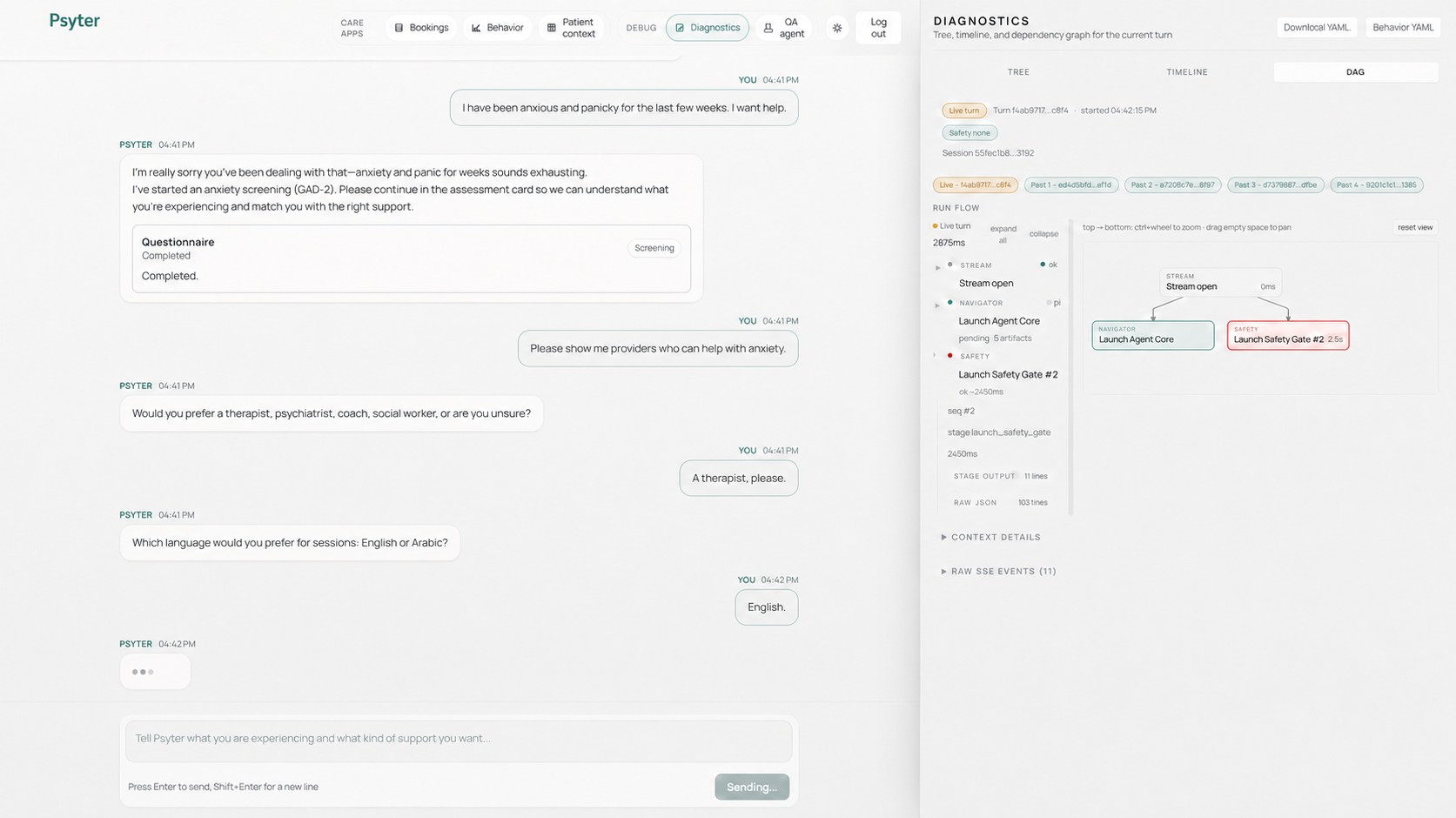
This system is not a black box. Every patient turn is paired with a diagnostic view of the exact run: the flow it took, the gates it passed, and the events it streamed. Left is what the patient sees; right is the evidence a reviewer opens.
flagship system · patient view + live diagnostics
One turn, fully traced. The patient has a calm, guided conversation while the diagnostics pane records the run flow, the safety gate, and every streamed event. The turn can be replayed and exported as YAML, not reconstructed from screenshots.
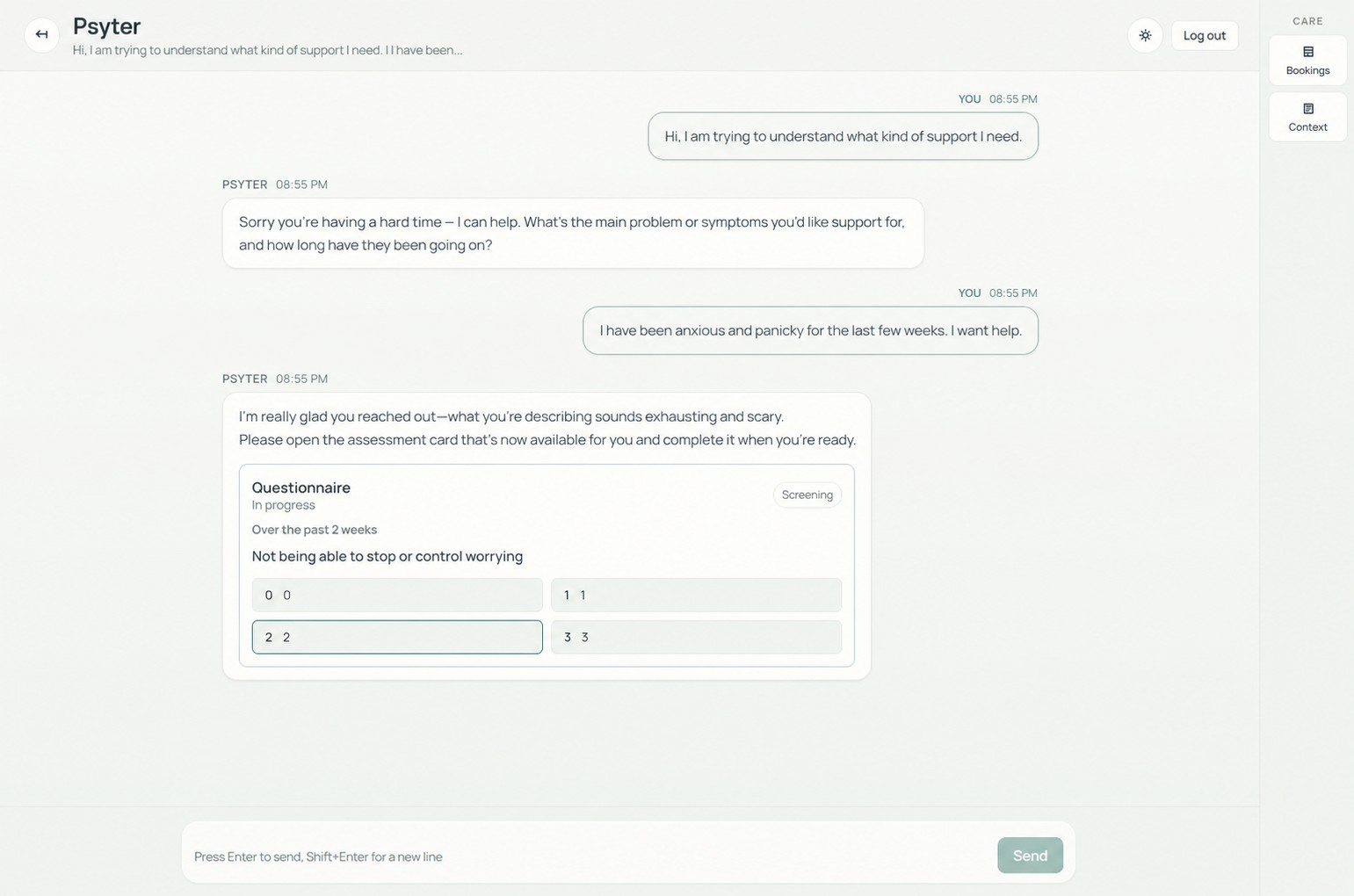
flagship system · structured intake
Safety-first intake. Distress is acknowledged, then a structured screening card is offered, before any routing happens.
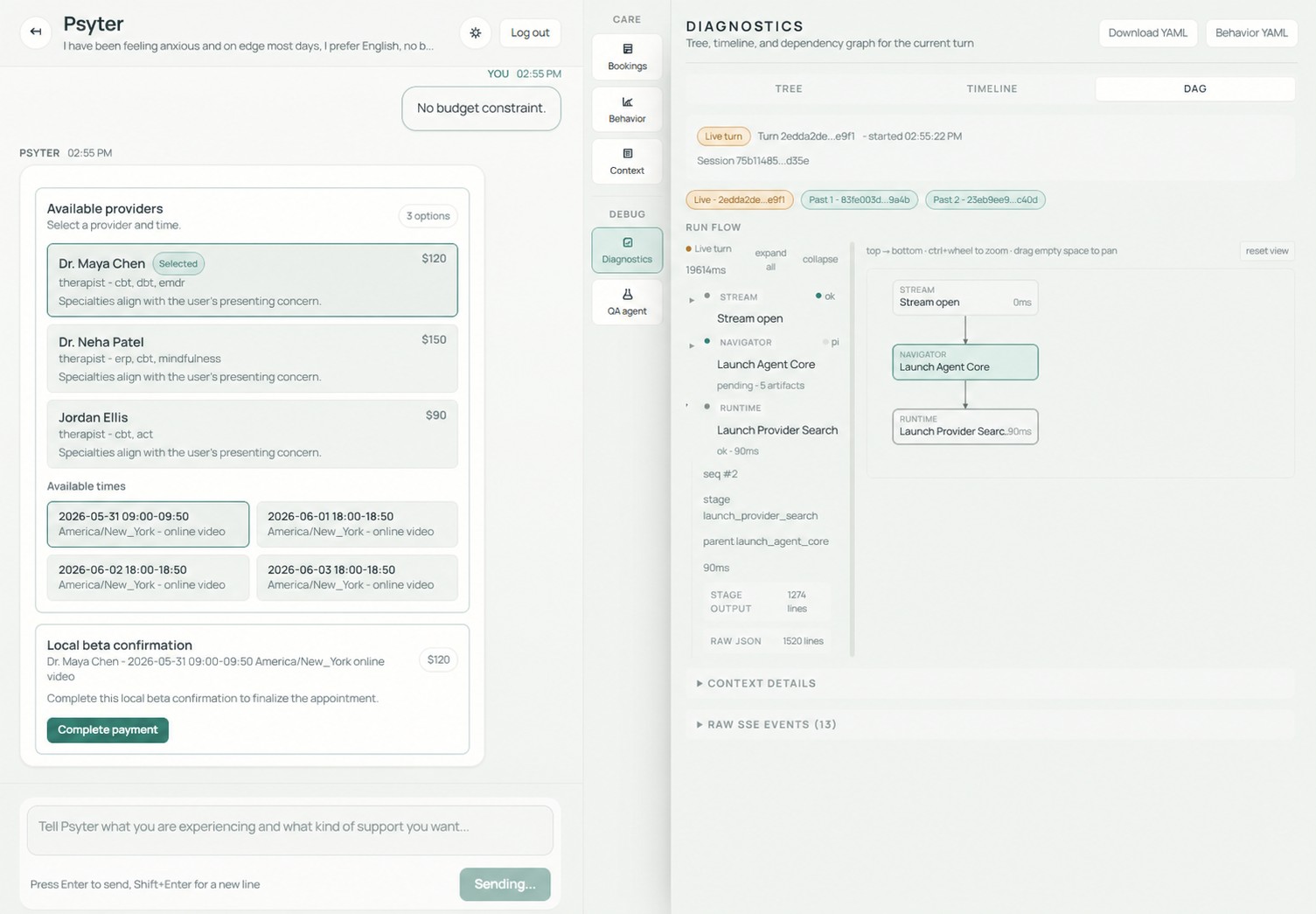
flagship system · matched booking + run graph
Real navigation to care. Matched providers, real slots, and a payment step, each backed by the run graph on the right.
The bar
Mental-health navigation is a workflow where a convincing demo and a passing approval review are two very different bars. A person in distress needs a system that asks the right questions, holds the right boundary, surfaces a credentialed match, books the appointment, takes payment, and follows up, without ever drifting into clinical interpretation or ignoring a crisis signal.
The first decision
The system's first design decision was not an agent. It was a PHI boundary. Before a single prompt was written, we applied for a Business Associate Agreement covering the OpenAI API organization that would handle protected health information, and attached the Healthcare Addendum to it. Every architecture choice after that treated those clauses as inputs, not legal formalities.
The build
Four layers, seven control planes, and phase-gated tool authority. Safety evaluation runs on every single turn against a policy versioned independently of the navigator prompt, and it holds authority the agent cannot override. When risk hits the high or crisis threshold, matching and booking become structurally unavailable, no matter what the prompt or the user asks for.
The release gate
The gate was not a passing demo. It was an evidence pack: realistic personas walked through the full workflow across every risk tier, with every turn's snapshot, gate outcome, tool call, and state write inspected against the role boundary. The slice shipped because the pack produced clean evidence.
7Control planes
4Architecture layers
100%Turns replay-ready
BAABounded from day one
SaaSToAgent delivered an agentic system for Psyter: BAA-bounded, phase-gated, safety-overridden, and replay-ready. Every turn of the patient journey produces evidence a reviewer can sign off on.
Left pane: the patient-facing navigation flow. Right pane: the live tracing view showing context assembly, safety state, gate outcomes, score breakdowns, and tool calls for the same turn.
How we de-risk it
Seven decisions, in order, before a single line ships
By the time we shipped the flagship system, we had learned the order the hard way. Make these decisions out of sequence — architecture before the compliance boundary, prompts before the role is fixed — and you pay for it later, rebuilding under pressure once a reviewer finds the gap. So we sequence them the way a project actually unfolds when it is held to real scrutiny. Each decision commits something the next one depends on.
1Compliance
Draw the compliance envelope
Decide where protected health information may flow, which services may touch it, and what is off-limits — before anything is designed. This boundary shapes every choice after it.
2Role
Fix the agent’s role
Write down what it may and may not do, and where a human must take over. Pin this before architecture, or the agent quietly drifts from navigation into decisions nobody approved.
3Architecture
Separate the control layers
Keep reasoning, permissions, execution, and the audit record as distinct layers, so each can be tested and changed on its own instead of tangled inside one prompt.
4First slice
Ship one narrow, complete workflow
One real path, end to end, that exercises every safety and audit control. Narrow but complete is the cheapest place to prove the whole system is real.
5Validation
Run realistic patients through it
Walk personas across the full journey, including the crisis cases and the awkward, incomplete ones the demo never showed. That is where the real failures surface.
6Evidence
Prove it with replay
Every turn leaves a record a compliance or clinical reviewer can inspect without an engineer translating. Review becomes reading evidence, not trusting a screenshot.
7Expansion
Release, then widen carefully
Add the next workflow only after the current one holds under real use. Each new slice re-enters the same path rather than bolting onto an unproven one.
None of this is theory. It is the path we walk on every healthcare build, and it is the difference between an agent that passes the demo and one that passes the approval review.
Trust and governance
Healthcare AI needs more than capability. It needs control.
In healthcare, the question is not only what an agent can do. The question is what it should be allowed to do, under what context, with whose approval, and with what audit trail.
HIPAA-aware development approach
PHI boundaries, access controls, human review gates, and audit trails are treated as core design requirements, decided before the first prompt is written rather than retrofitted before launch.
BAA with OpenAI for eligible services
SaaSToAgent maintains a BAA with OpenAI for eligible services, helping healthcare teams design within the right compliance envelope. PHI paths are checked against the approved organization, project, and endpoint allowlist.
Governed agentic workflows
Agents are designed around what they can see, what they can do, when they need approval, and when they must escalate. Each boundary is enforced at runtime and verifiable in replay, not stated in a prompt.
Proven AI agent delivery
Independent client reviews of our agent engineering work are published on Clutch and GoodFirms.
Compliance leads, clinical operations, and engineering all have to approve a healthcare agent before it ships. Here is what that looks like when it works.
Verified client
“Evidence a reviewer can sign off on”
SaaSToAgent delivered an agentic system for Psyter. It is BAA-bounded, phase-gated, safety-overridden, and replay-ready. Every turn of the patient journey produces evidence a reviewer can sign off on.
MA
Dr. Majid AldesoukiDirector, Psyter · Client location · Saudi Arabia
Client review
“Intake stopped being a bottleneck”
Patients used to wait in a queue while staff pieced their information together by hand. The governed intake agent gathers context, checks it is complete, and flags anything urgent to a person straight away. Our team spends its time on care, not on chasing forms.
SH
Dr. SatiFounder, Sai Hospital · Client location · India
Client review
“Prior authorizations without the backlog”
Authorizations used to stall our reimbursements and frustrate staff. The agent now assembles each packet, keeps its status visible across the team, and holds submission behind a named approval. We can finally see where every request stands.
RC
Healthcare operations leaderMulti-specialty provider · Client location · United States
Client review
“Documentation, ready for review in minutes”
Notes used to follow our clinicians home. The documentation agent drafts and organizes the administrative record, scoped to what each phase should see, and nothing reaches the chart without a clinician approving it. It gave our providers their evenings back.
CM
Clinical operations leadBehavioral health provider · Client location · United Kingdom
Client review
“Our compliance team could finally read the record”
What sold us was not the demo, it was the replay. Every turn is recorded with the context the agent saw and the gates it passed, so compliance and clinical review work from the same evidence our engineers do. Sign-off went from weeks to a working session.
HS
Compliance leadHealth system · Client location · Singapore
Across care environments
Healthcare agentic transformation across specialties
Different specialties have different workflows, risks, and approval points. SaaSToAgent designs agents around the operational reality of each care environment.
Primary Care
Behavioral Health
Psychology / Mental Health
IOP / PHP Programs
Urgent Care
Physical Therapy
Wound Care
Ophthalmology
Orthopedics
Internal Medicine
Dermatology
Pediatrics
Gastroenterology
Oncology
Cardiology
Neurology
Multi-specialty Clinics
Hospitals & Health Systems
Healthcare SaaS Platforms
Two ways to start
Wherever you are with it, the next step is a conversation
Path A · You know the workflow
Request an agentic transformation roadmap
Best if you want help choosing the right workflow and planning the safest first step. We map the opportunity, identify the risks, and give you a practical roadmap your team can use.
You get: a written roadmap with clear priorities
Known risks: workflow, data, and approval boundaries made visible
A practical first step your team can review before committing
Best if you are still deciding whether agents make sense for you. A free 30-minute call, no commitment: we help you spot the workflow worth starting with, and tell you honestly if an agent is the wrong tool.
Free & no obligation — an engineer, not a salesperson
We help you choose which workflow is worth doing first
You leave with direction, even if you build nothing with us
What does SaaSToAgent build for healthcare companies?
SaaSToAgent helps healthcare teams and healthcare SaaS companies design governed agentic workflows where agents can use context, tools, permissions, approvals, and audit trails to support real operational tasks.
Is this just a healthcare chatbot?
No. A chatbot mainly responds to messages. SaaSToAgent focuses on governed healthcare agents that can understand workflow state, use approved tools, follow action boundaries, escalate when needed, and support auditable execution.
How do you approach HIPAA compliance?
We start with the compliance envelope: PHI boundaries, eligible services, access controls, retention assumptions, audit requirements, human review, and data minimization. SaaSToAgent also maintains a BAA with OpenAI for eligible services. Compliance itself also depends on your organization's agreements, policies, workforce training, and configuration, so we design inside your envelope and document what each control does and does not cover.
Can agents make clinical decisions?
No. We position agents as workflow, navigation, coordination, documentation, intake, admin, and operational support systems. They do not diagnose, provide therapy, advise on medication, or replace clinicians, and human review gates sit in front of clinical, financial, and privacy-sensitive output.
What is the first step?
Start with one narrow healthcare workflow where the operational burden is clear. SaaSToAgent maps the workflow, defines context and action boundaries, adds governance, and validates the first agentic release slice before expansion.
Who is this for?
Healthcare SaaS companies, hospitals, IOP and PHP programs, patient access platforms, doctor booking platforms, multi-specialty clinics, and healthcare operations teams.
Why SaaSToAgent
Governance-first healthcare AI, built to pass the review
100%Of turns replay-ready for clinical & compliance review
Start with one safe healthcare workflow
Choose one workflow where your team already feels the operational load. SaaSToAgent helps map the context, define the action boundaries, add governance, and validate the first agentic release slice before expansion.