
AI agents can read codebases, search documents, remember conversations, inspect system state, and call APIs. Yet more context does not always lead to better decisions.
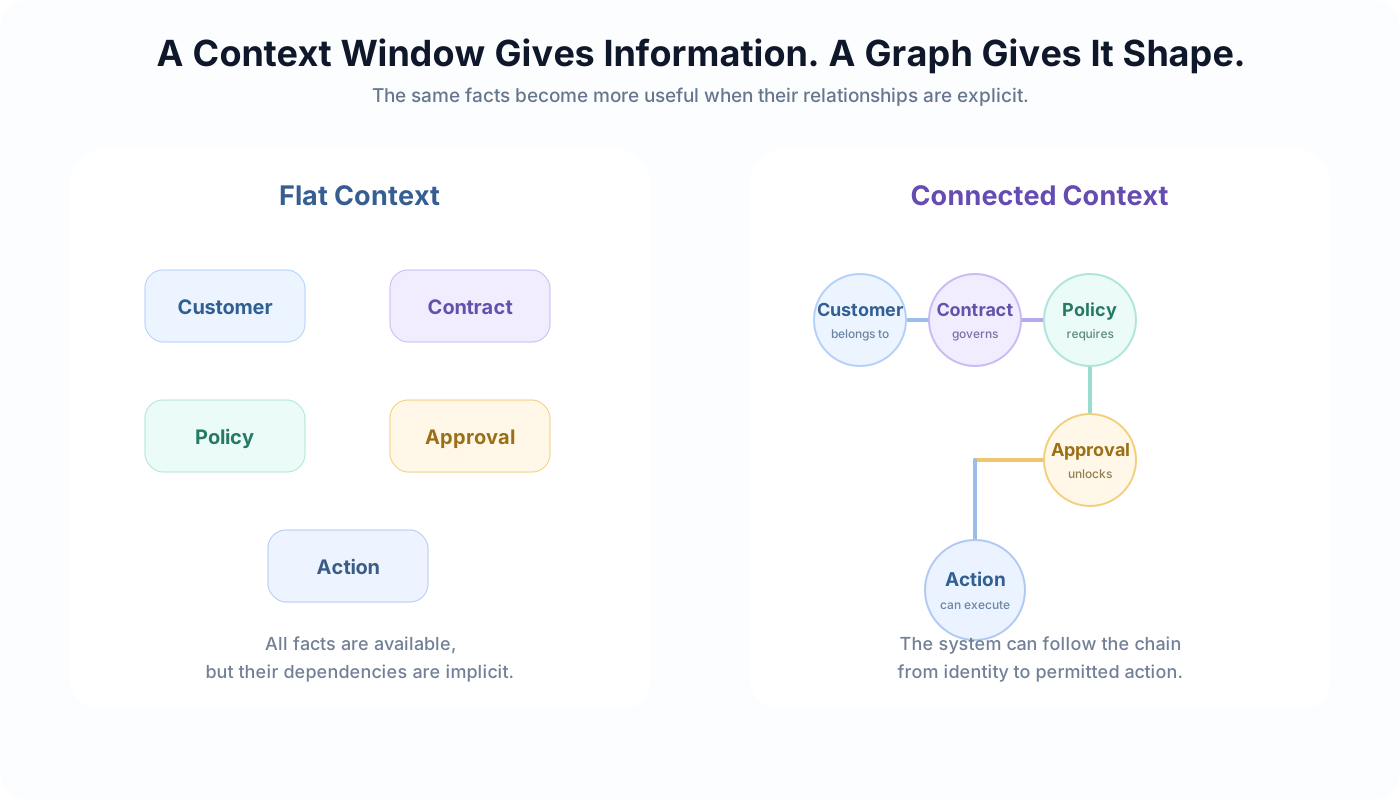
The problem is often not missing information, but missing relationships. A customer may belong to an account governed by a contract that overrides a standard policy and requires approval before an action can be taken.
The AI may have every fact in context and still fail to understand how those facts connect.
For AI agents, understanding relationships may matter as much as having the information itself.
Your AI Has More Context Than Ever. So Why Does It Still Get Things Wrong?
AI engineering has increasingly focused on giving models better context through larger context windows, retrieval-augmented generation, memory, tools, schemas, repository instructions, and internal documentation. That makes sense: a model cannot reason well about information it cannot see.
But context alone has limits.
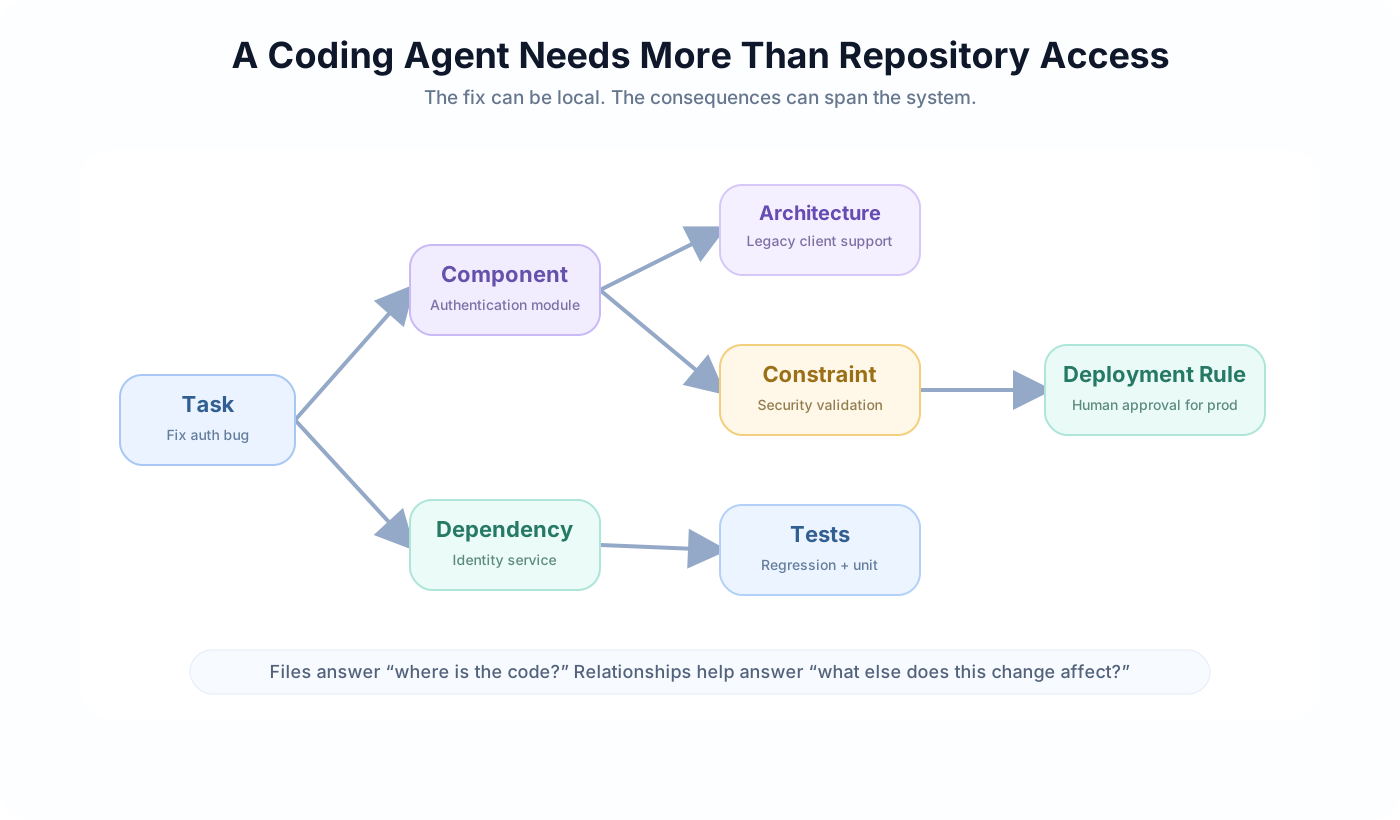
A coding agent may have every file related to authentication and still miss that the module affects a mobile app, depends on an identity service, follows a security constraint, or requires specific tests before deployment.
The information may already exist. The harder problem is understanding how each piece relates to the rest of the system.
That is where the conversation starts shifting from simply providing context to structuring it.
The Missing Piece Is Relationships
Consider a customer asking:
Can I cancel my subscription today without paying an early-termination fee?
A retrieval system might find the cancellation policy, the customer profile, and the contract. But answering correctly may require understanding a chain like this:
Customer → Enterprise Account → Contract → Contract Version → Renewal Date → Cancellation Clause → Approved Exception
The answer does not necessarily live in one document. It can emerge from the relationships between several pieces of information.
That is the basic idea behind graph-based systems. Instead of treating information as disconnected chunks, a graph represents entities and their relationships.
For example:
Customer → has → SubscriptionSubscription → governed by → ContractContract → overrides → Standard PolicyPolicy → requires → Finance Approval
All four facts could already exist inside an AI model's context. The graph makes the connections between them explicit.
A context window gives AI information. A graph gives that information a shape.
A Coding Agent Can Read Your Repository and Still Misunderstand It
Coding agents make this problem easy to see.
Ask an agent to fix an authentication bug, and it may find the faulty function, change a few lines, and pass the unit tests. Locally, the fix looks correct.
But that function may support an older mobile client, enforce a security requirement, or affect another service. Reading the code is not enough if the agent cannot understand those dependencies.
What the agent needs is a map of the system:
Task → Component → Dependency → Architecture Decision → Constraint → Test → Deployment Rule
Giving the agent access to every file answers one question: What information can you see?
A structured system map answers a more important one: What does this change affect?
As coding agents move from suggesting changes to making them more autonomously, that second question becomes much more important.
This Is Where Graph Engineering Starts to Matter
The phrase graph engineering is still emerging, and it does not yet have one universally accepted definition. In AI systems, however, two interpretations are especially useful.
- The first is a graph of information: how customers, documents, services, policies, users, events, and other entities relate to each other.
- The second is a graph of execution: how an AI system moves from one step to another while maintaining state and following rules.
Consider these two structures:
Customer → Account → Contract → Policy → Permission
Request → Validate → Approve → Execute → Verify
They look similar, but they answer different questions. The first tells the AI what is connected. The second tells the system what is allowed to happen next.
Production AI agents may increasingly need both.
RAG Finds Information. Graphs Help Connect It.
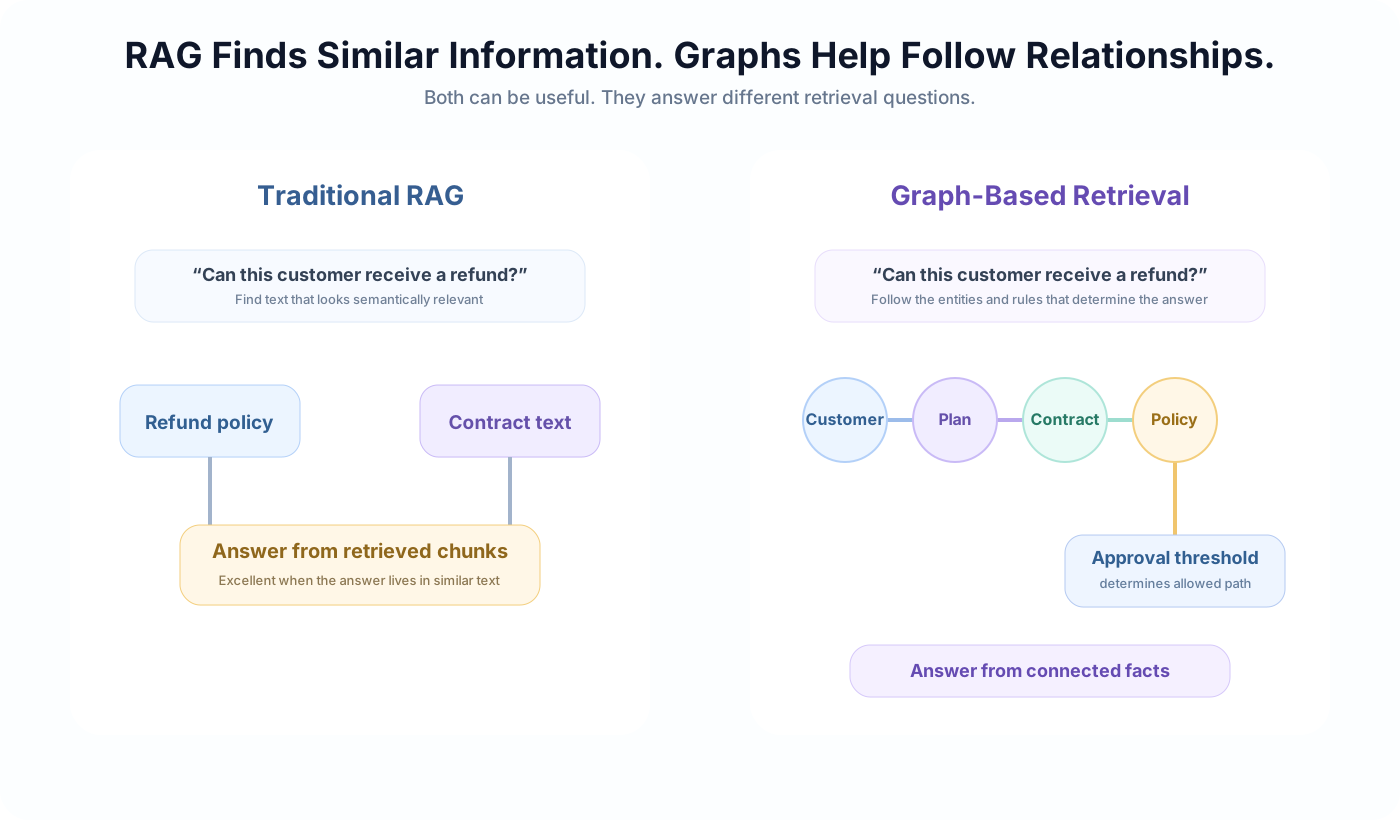
Traditional retrieval-augmented generation is effective when the goal is to find information similar to a user's question.
Ask:
What is our refund policy?
A vector-based retrieval system can usually find the relevant policy.
But ask:
Can this enterprise customer receive a refund without finance approval?
Now the answer may depend on the customer's plan, contract, transaction amount, policy version, previous exceptions, and approval threshold. Similarity alone may not capture those relationships.
This is where graph-based retrieval differs.
Traditional RAG asks: What information looks relevant?
Graph-based retrieval also asks: What information is connected to the entity or situation we are reasoning about?
For simple documentation search, that distinction may not matter. For multi-step enterprise decisions, it often does.
Graph-based retrieval does not need to replace conventional RAG everywhere. Its value appears when the answer depends not only on finding information, but on following relationships across multiple pieces of it.
A Wrong Answer Is Annoying. A Wrong API Call Is Different.
The importance of relationships increases when AI stops answering questions and starts taking actions.
Imagine a customer-support agent with access to get_customer(), check_contract(), cancel_subscription(), and issue_refund().
Now suppose refunds above $5,000 require finance approval. Should that rule exist only inside a prompt telling the model to “follow company policy”? Probably not.
Some parts of a workflow should be enforced by the system itself.
A safer process might look like this:
Refund Request → Identity Check → Purchase Validation → Policy Evaluation → Approval Check → Refund → Verification
The AI can still interpret an unusual customer request or determine whether an exception might apply. What it should not necessarily do is invent the entire process each time.
Use AI for ambiguity. Use structure for rules.
The more powerful the agent's tools become, the more important those boundaries are.
Three Different Graphs an AI Agent May Need
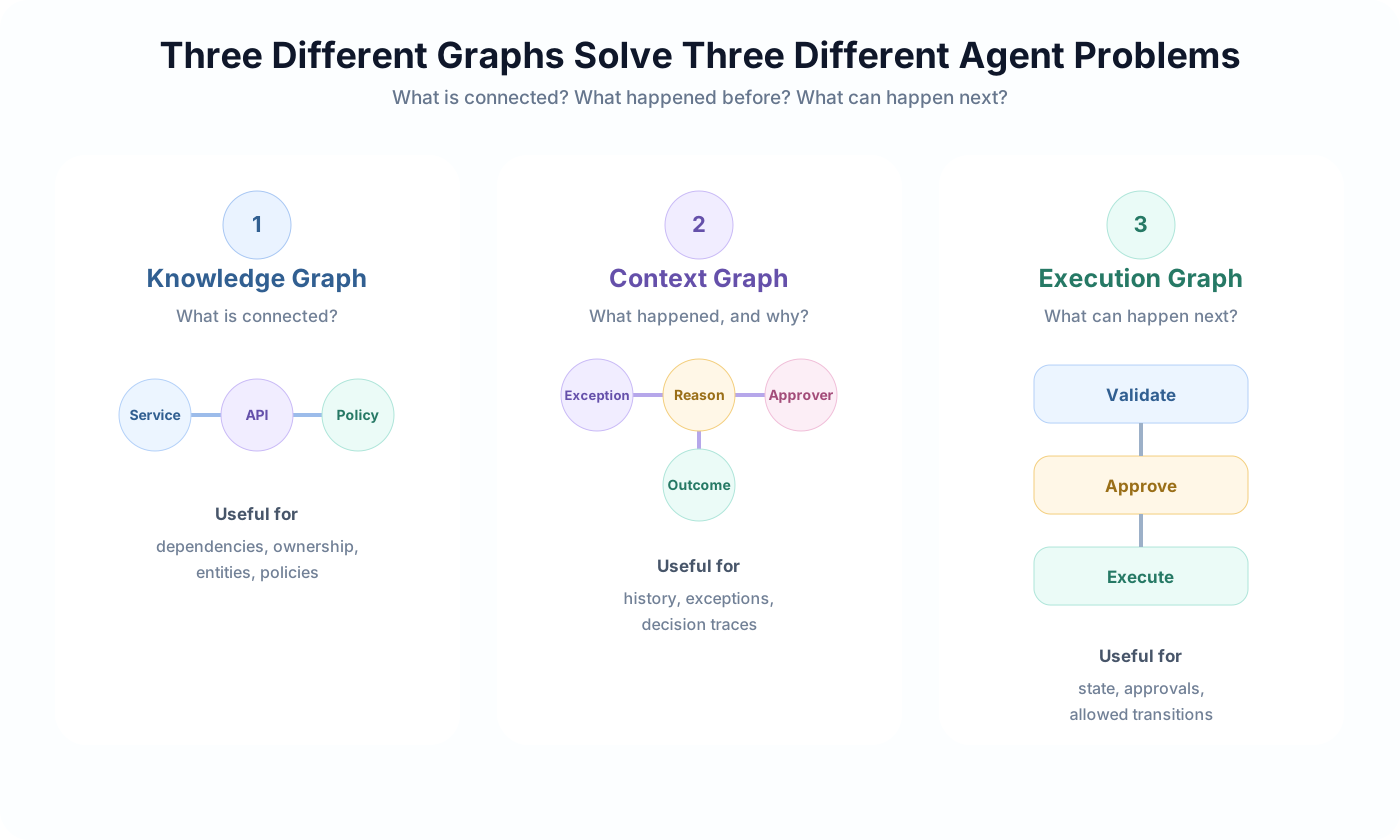
The word “graph” can describe several architectures. For AI agents, three are particularly useful.
1. Knowledge Graph: What Is Connected?
A knowledge graph represents entities and relationships.
Authentication Service → depends on → Identity APIIdentity API → owned by → Platform TeamPlatform Team → follows → Security Policy
This is useful when the answer depends on navigating connected information rather than retrieving a single document.
2. Context Graph: What Happened, and Why?
A context graph adds history and decision traces.
Customer → received exception → approved by manager → under Policy v3 → because of service outage
This gives the agent more than the final outcome. It also preserves the circumstances surrounding the decision.
But historical decisions introduce an important challenge: a previous exception should not automatically become a rule. An AI system must distinguish between policy, precedent, exception, and historical context if it is going to reason reliably from past decisions.
3. Execution Graph: What Can Happen Next?
An execution graph represents allowed transitions.
Request → Validate → Approve → Execute
or:
Request → Validate → Reject
This creates a clear boundary around autonomy. The AI may reason inside an individual step, but the surrounding system determines which steps exist and which transitions are permitted.
What Happens When You Put the Three Together?
Return to the customer asking:
Cancel our subscription and refund the latest payment.
The knowledge graph identifies the customer's organization, subscription, contract, and applicable policy. The context graph surfaces relevant previous decisions, exceptions, or historical circumstances. The execution graph determines whether the requester has permission, whether approval is required, which action can happen next, and how the result should be verified.
The AI model still plays a critical role. It can interpret intent, understand ambiguous language, reason over unusual situations, and communicate with the user.
But it is no longer expected to carry the entire organization, permission model, workflow logic, and operational history inside one large prompt.
Instead, it operates inside a structured representation of the system.
That is the architectural shift that makes graph engineering interesting.
When Does Graph Engineering Actually Make Sense?
Not every AI application needs graph engineering.
If your AI answers straightforward questions from a small documentation library, standard RAG may be enough. If the workflow is simple and linear, conventional application code may be easier to build and maintain.
Graphs become more valuable when relationships themselves determine the answer or action.
That often appears in questions such as:
- Which policy applies to this account?
- What systems could this code change affect?
- Who must approve this action?
- Which previous decision is relevant?
- What state is this workflow currently in?
- What actions are allowed from here?
The recurring pattern is:
Entity → Relationship → State → Rule → Action
When your AI needs to traverse that structure repeatedly, treating context as a flat collection of text chunks can become limiting.
The Next Bottleneck May Not Be Model Intelligence
Knowledge graphs, state machines, dependency graphs, and workflow engines are not new technologies. What has changed is the role of AI inside them.
Modern agents can increasingly read private data, modify code, call enterprise APIs, interact with software, and make decisions that change real system state. At that point, relationships are no longer just a data-modeling concern.
A dependency can determine whether a code change is safe. A permission can determine whether an API call is allowed. A previous exception can influence how a customer request should be interpreted. A workflow state can determine which action is possible next.
For years, AI progress has been measured through smarter models, larger context windows, better reasoning, more memory, and more tools. Production agents may expose a different bottleneck.
The model may already be capable enough. The surrounding system may not be structured enough.
An agent with access to many tools but no understanding of when they apply is not necessarily autonomous. An agent with a hundred documents but no understanding of which policy overrides another is not necessarily informed. An agent that remembers every past decision but cannot distinguish an exception from a rule is not necessarily knowledgeable.
So perhaps the next question should not be:
How much context can our AI hold?
It should be:
Does our AI understand how that context connects?
What depends on what? Which information is still valid? Which rule applies? What can happen next? And what must never happen automatically?
Your AI may already have enough context. The harder problem is making sure it understands the system that context describes.
That is why graph engineering is worth paying attention to.